The Final Call |
National News
Prison isolation cells violate human rights, charges petition
By Charlene Muhammad and Ernesto Arce | Last updated: Mar 30, 2012 - 1:33:11 PMWhat's your opinion on this article?
LOS ANGELES (FinalCall.com) - Inmates isolated in California prisons’ Security Housing Units (SHUs) have petitioned the United Nations to intervene in what they and human rights groups say is cruel and inhumane punishment.
According to the Center for Human Rights and Constitutional Law, treatment of California prisoners placed in solitary confinement constitutes a violation of human rights that should be brought before the world body.
On March 20, the foundation presented UN officials with a petition on mass human rights violations in the U.S on behalf of approximately 4,000 inmates isolated in California’s prisons.
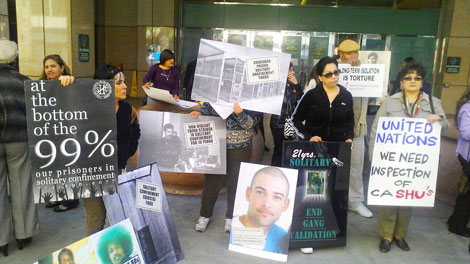
Prisoner advocates and family members of incarcerated men present a petition to the UN on behalf of inmates inside California SHU, Secured Housing Units. The segregated
inmates allege that solitary confi nement constitutes cruel & unusual punishment. Photo: Ernesto Arce
|
The petition includes confidential testimony of 22 main petitioners, men being detained inside the Pelican Bay State Prison SHU from between one to at least 39 years, according to family members and advocates.
“The petition is against the state of California, Governor Jerry Brown, and CDCR Secretary Matthew Cate and CDCR and we want the United Nations to take over the petition, intervene inside California and allow the Red Cross to enter prisons to medically treat the inmates,” said an emotional Kendra Castaneda, speaking on behalf of her husband and his fellow inmates.
She called the petition a historic step for the most forgotten members of society.
“What I’ve noticed is many of these men were either helping others, jail house lawyers, got along with the other races, are extremely intelligent, and are extremely segregated and controlled, and the rest are on the yard. This isn’t how it should be,” Ms. Castaneda said.
The UN petition was initiated by Peter Schey, the center’s executive director, after the statewide prisoner hunger strike in July, 2011. Inmates protested being detained in the SHUs, some for indefinite or determinate periods, because of alleged gang affiliation. They charge that the California Department of Corrections and Rehabilitation tags them as so-called gang members through an unjust validation process with no way out of such labels, and that the validations prolong their detention.
The petition was delivered to the UN’s Working Group on Arbitrary Detention, Human Rights Council, and General Assembly at its offices inside the Ronald Reagan state building in downtown Los Angeles.
Prisoner advocates and family members of many men incarcerated in the SHUs gathered there on the same day to plead their case.
“The 22 men on the petition are revealing for the first time their mental, physical experiences, which they’ve never revealed to anybody before and it’s all different races, all different races. ... They’re doing anything that they can to get their voices heard and the Center for Human Rights is just trying to help get that going,” Ms. Castaneda said.
Testimony provided by the men reveals deep levels of desperation.
Walter Codo, CDC inmate number J-88438, calls his segregation a living hell. Alfred Sandoval, CDC inmate number D-61000, said, “I have seen fellow prisoners murdered by correctional officers, mentally ill prisoners abused. I have seen men psychologically break down, cry, scream and go insane. The SHU is a soul sucking, mind-bending torture that murders all humanity in any human being.”
According to the petition, some of the inmates endure under-portioned, watered-down, undercooked or spoiled food. And one inmates charges he was told by custody and medical staff at various times over the past 22 years “the only way he will ever be freed from isolated segregation—and thereby end his suffering and receive needed medical care—is if he paroles, dies, or agrees to become a known informant against others for state authorities.”
The center says placing thousands of prisoners in segregation for long periods of time is one of the most serious mass human rights violations taking place in the U.S. today.
Prisoner advocates say the petition is one of many efforts to drum up international pressure on the CDCR.
According to the CDCR, the SHU program is necessary to contain violent inmates, stop prison gangs and ensure the safety of its staff. But family members of some SHU inmates insist their loved ones were “validated” in a process known as gang or security threat identification—though cited for non-violent petty offenses.
Silvia Rogokos’ brother is in Pelican Bay SHU where he was recently revalidated for having an Aztec calendar and a drawing of Mexican artist Frida Kahlo. Prison authorities consider the artwork gang affiliated, according to his mother, and he’s been in solitary confinement for 21 years.
Several treaties obligate the U.S. to conform to international standards against torture and inhumane treatment, such as the Geneva Conventions and the UN Convention Against Torture. Solitary confinement is considered by many experts to be a form of psychological torture.
Dolores Canales’ son is being housed in the SHU at Pelican Bay State Prison. He’s been in isolation for more than 11 years and the last time she saw him, he was thin and pale to the point of being unrecognizable, she said.
Ms. Canalas added that she isn’t asking for her son to be released, just that he be treated humanely.
“He has no skin color whatsoever ... He’s being held in a soundproof cell, windowless, no exposure to sun whatsoever... You know that the main goal here is to turn his brain to mush,” Ms. Canalas said.
Advocacy groups cited in the petition, in addition to the center, are California Prison Focus, Families to Amend California’s Three Strikes, Fair Chance Project, California Families to Abolish Solitary Confinement, Justice for Families, The Real Cost of Prisons Project, American Friends Service Committee, Community Futures Collective, Center for Prisoner Health and Human Rights, California Prison Moratorium Project, Legal Services for Prisoners with Children, Disability Rights Legal Center, Disability Rights California, and the League of United Latin-American Citizens.

News Search
Loading
Follow The FinalCall.com Networks



Join The FinalCall.com e-List


 Click Here Stay Connected!


For Email Marketing you can trust
Farrakhan Articles
- Unmasking Mr. Dershowitz
- Activists charge environmental poisoning and ‘silent homicide’ in San Francisco
- President spews more incendiary rhetoric as election draws closer
- Covid-19 and the divine chastisement of Florida
- The National Guard was deployed in Atlanta, what does this mean as shootings, violence plague other American cities?
- Our babies are dying, where are our friends?
- Hurling truth at Falsehood Nation of Islam responds to lies of Atty. Alan Dershowitz
- The impact of a universal message
- Police traffic stops in nation’s capital disproportionately target Blacks
- A Call to Action’ to address Covid-19 in Black Chicago
INSIDE STORIES AND REVIEWS
-

-

About Harriett ... and the Negro Hollywood Road Show
By Rabiah Muhammad, Guest Columnist » Full Story -

Skepticism greets Jay-Z, NFL talk of inspiring change
By Bryan 18X Crawford and Richard B. Muhammad The Final Call Newspaper @TheFinalCall » Full Story -

The painful problem of Black girls and suicide
By Charlene Muhammad -National Correspondent- » Full Story -

-

-

-

Exploitation of Innocence - Report: Perceptions, policies hurting Black girls
By Charlene Muhammad -National Correspondent- » Full Story -

Big Ballin: Big ideas fuel a father’s Big Baller Brand and brash business sense
By Bryan Crawford -Contributing Writer- » Full Story -
