The Final Call |
National News
Charges of corruption, obstruction of justice haunt Trump
By Askia Muhammad -Senior Editor- | Last updated: Jun 14, 2017 - 11:16:38 AMWhat's your opinion on this article?
|
WASHINGTON—Donald J. Trump, the President of the United States, is a liar.
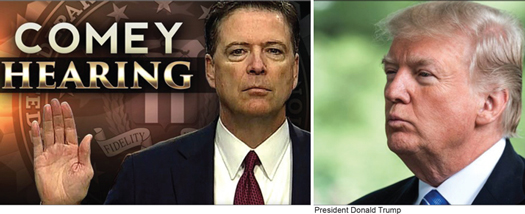
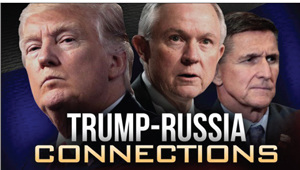
This according to James Comey, the recently fired director of the Federal Bureau of Investigation (FBI), who testified in a dramatic session before a Select Senate Intelligence Committee in early June, that Mr. Trump tried to derail an investigation into fired National Security Adviser Michael Flynn’s links to Russia, and accused the president of lying about why he was later removed from office.
|
“Although the law required no reason at all to fire an FBI director, the administration then chose to defame me and, more importantly, the FBI, by saying that the organization was in disarray, that it was poorly led, that the workforce had lost confidence in its leader,” Mr. Comey said. “Those were lies, plain and simple.
“So, it confused me when I saw on television the president saying that he actually fired me because of the Russia investigation, and learned again, from the media, that he was telling, privately, other parties that my firing had relieved great pressure on the Russia investigation,” Mr. Comey said in his June 8 testimony. “I was also confused by the initial explanation that was offered publicly, that I was fired because of the decisions I had made during the election year. That didn’t make sense to me for a whole bunch of reasons, including the time and all the water that had gone under the bridge since those hard decisions that had to be made.”
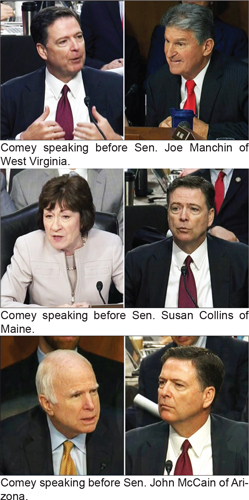
Mr. Comey detailed how President Trump repeatedly cornered him in one-on-one meetings, asking him to declare his loyalty to the president and pressuring him to back off the investigation into Gen. Flynn.
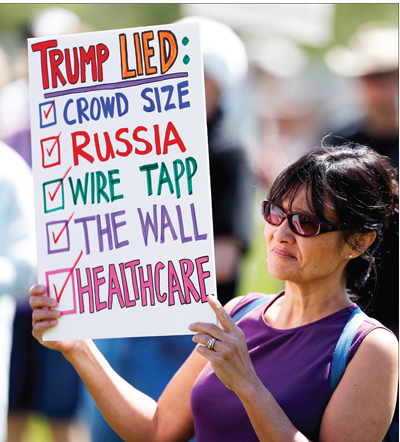
Fe Baron of Boulder, Colo., holds up a sign during a protest against the polices of President Donald Trump Saturday, June 3, in downtown Denver. The anti-Trump rally featured speakers calling for resistance to the administration. Photo: AP/Wide World photos
|
For anxious Democrats and other opponents of the Trump administration who worry that the president sought to “obstruct justice,” and had committed as many other impeachable offenses and gross political blunders as it took disgraced former President Richard Nixon nearly five and a half years to commit, the hearing was a high water mark, and it riveted national attention, drawing nearly 20 million viewers to the early morning spectacle, more than had watched the NBA Finals in prime time, earlier that week.
|
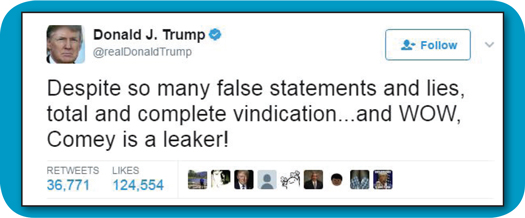
But to Mr. Trump, the testimony, which amounted to “lies,” by Mr. Comey, also served as a “vindication” that he had not personally been under investigation, as he claimed throughout the campaign. And his supporters were relieved that there was no “smoking gun” revealed exposing the president’s obvious guilt.
|
“No collusion. No obstruction. He’s a leaker,” Mr. Trump repeated the following day during a Rose Garden press conference with Romanian President Klaus Iohannis. “We were very, very happy,” he continued, “and frankly, James Comey confirmed a lot of what I said. And some of the things he said just weren’t true.”
Mr. Trump even insisted he was willing to testify under oath about his conversations with Mr. Comey. “One hundred percent,” Mr. Trump said when asked about his willingness to deliver sworn testimony.
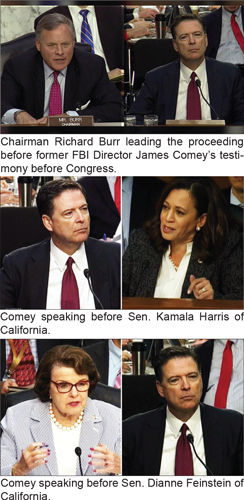
In his testimony, Mr. Comey had been emphatic, explaining why he decided to make written records of his meetings with Mr. Trump, beginning even before he was sworn in, because he believed the president might lie about what had taken place. “I was alone with the president of the United States, or the president-elect, soon to be president,” Mr. Comey said in answer to a question from Committee Vice Chairman Mark Warner (D-Va.).
|
“I created records after conversations, and I think I did it after each of our nine conversations. If I didn’t, I did it for nearly all of them, especially the ones that were substantive. I knew that there might come a day when I would need a record of what had happened, not just to defend myself, but to defend the FBI and our integrity as an institution and the independence of our investigative function. That’s what made this so—so difficult, is it was a combination of circumstances, subject matter and the particular person,” Mr. Comey testified.
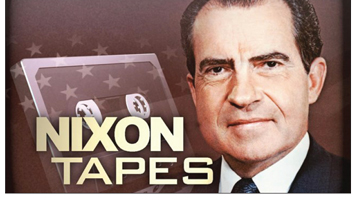
The similarities today to the shocking, almost daily, scandalous revelations revealed during the Watergate impeachment scandal surrounding President Richard Nixon have led Mr. Trump’s opponents to anticipate his downfall—the firing of the person investigating possible presidential wrongdoing; as well as a mystery surrounding the revelation that the president’s White House conversations had been secretly recorded.
“When you go back to United States vs. Nixon, the Chief Justice Warren Burger’s decision in the case. It was ‘conspiracy to obstruct justice,’ ” Gloria Browne-Marshall, associate professor of Constitutional Law at John Jay College of Criminal Justice in New York said in response to a question from this writer, during Pacifica Radio’s live national coverage of the Comey hearing.
Those charges led to Mr. Nixon’s undoing, with articles of impeachment passing the House Judiciary Committee, which led to Mr. Nixon’s subsequent resignation in August, 1974, rather than face certain impeachment by the full House, and likely conviction and removal from office by two thirds of the Senate.
|
While Mr. Trump and his supporters were almost giddy about what they perceived to be the absence of really damaging testimony coming from Mr. Comey, other observers contend the threshold has been crossed. “I think we do,” have a “smoking gun” proving Mr. Trump’s guilt, Elizabeth Goitein, co-director of the Liberty & National Security Program at the Brennan Center for Justice said in an interview.
“I think Comey’s testimony stood up in the hearing. And his testimony was that the president explicitly asked him to ‘let it go.’ Those were his words, to ‘let go’ of the investigation into Michael Flynn, the former National Security Adviser.
“And that right there is pretty much what obstruction of justice looks like. It’s basically when somebody tries to impede, or interfere with, or obstruct, the due administration of justice. When the president tells the FBI director to lay off an investigation into his crony, or his aide, or his associate, that’s a pretty strong case.”
But observers must not be too quick to make champions out of the FBI, because that agency has its own sordid record of abuses, abuses with which Black people in this country, veterans of the Civil Rights and anti-war movements are well acquainted with.
“Absolutely. I don’t think there are any heroes necessarily in this story,” Ms. Goitein said in response to a question from this writer. “Yes. The FBI has a fairly notorious history of cracking down on civil rights groups, and conducting improper surveillance and intelligence gathering on Americans.
“Certainly after 9-11, the FBI was one of the agencies that really set its sights on Muslim American communities, and began mapping out Muslim American communities, specifically, and keeping tabs on them, sending informants into mosques, that kind of thing.
“So, it’s not so much that I think that the FBI is the champion of our democratic freedoms exactly. I think this is a very situational moment, where we need to look at what the president did, what James Comey is saying the president did, whether he’s credible, and if he is credible, what does that mean? What does that mean for our democracy? What does that mean for the rule of law?” Ms. Goitein said.

News Search
Loading
Follow The FinalCall.com Networks



Join The FinalCall.com e-List


 Click Here Stay Connected!


For Email Marketing you can trust
Farrakhan Articles
- Unmasking Mr. Dershowitz
- Activists charge environmental poisoning and ‘silent homicide’ in San Francisco
- President spews more incendiary rhetoric as election draws closer
- Covid-19 and the divine chastisement of Florida
- The National Guard was deployed in Atlanta, what does this mean as shootings, violence plague other American cities?
- Our babies are dying, where are our friends?
- Hurling truth at Falsehood Nation of Islam responds to lies of Atty. Alan Dershowitz
- The impact of a universal message
- Police traffic stops in nation’s capital disproportionately target Blacks
- A Call to Action’ to address Covid-19 in Black Chicago
INSIDE STORIES AND REVIEWS
-

-

About Harriett ... and the Negro Hollywood Road Show
By Rabiah Muhammad, Guest Columnist » Full Story -

Skepticism greets Jay-Z, NFL talk of inspiring change
By Bryan 18X Crawford and Richard B. Muhammad The Final Call Newspaper @TheFinalCall » Full Story -

The painful problem of Black girls and suicide
By Charlene Muhammad -National Correspondent- » Full Story -

-

-

-

Exploitation of Innocence - Report: Perceptions, policies hurting Black girls
By Charlene Muhammad -National Correspondent- » Full Story -

Big Ballin: Big ideas fuel a father’s Big Baller Brand and brash business sense
By Bryan Crawford -Contributing Writer- » Full Story -
