The Final Call |
National News
Preparing for disaster—are you ready?
By Jerry Muhammad | Last updated: Jul 11, 2006 - 6:56:00 PMWhat's your opinion on this article?
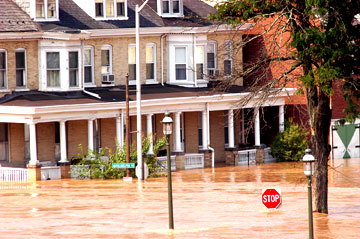
Buildings are engulfed as flood waters crest along the Delaware River June 29 in Easton, Penn. On June 28, Gov. Ed. Rendell declared a disaster emergency in 46 of the state's 67 counties. Photo: William Thomas Cain/Getty Images
|
BROOKLYN, NY (FinalCall.com) - In 2003, a major earthquake in Southeastern Iran killed nearly 15,000 people. In March of this year, a similar earthquake hit Iran, once again ravaging the country. In December 2004, a tsunami devastated the lives of 230,000 people in South Asia, stretching all the way to the coast of East Africa. And in 2005, Hurricane Katrina flooded the southern part of Louisiana and Mississippi leaving over 1,000 dead and thousands more evacuated to cities throughout the country, making it one of the worst natural disasters in United States history.
With one-in-four New Yorkers living in a hurricane evacuation zone, the National Oceanic & Atmospheric Administration (NOAA) is predicting the Northeastern part of the U.S. to possibly be hit by a Category 5 hurricane in the very near future. While at the same time, seismologists are predicting a long overdue magnitude 6.0 earthquake to hit Brooklyn, which may cause $20 billion in damages. The expectations among the general populace, who are untrained for disasters and lack emergency evacuation planning, calls for defined guidelines as to the independent actions necessary for their survival. The lack of disaster preparedness cannot be more evident as demonstrated within the Black, Latino, and poor neighborhoods of New York City.
Sponsored by the Brooklyn Local Organizing Committee of the Millions More Movement (LOC), the two-day intensive Management Disaster Preparedness course, held June 10-11 at the Fort Greene Senior Citizen Center at 966 Fulton Street, gathered people from Manhattan, Brooklyn and Queens to learn about their vulnerability and what actions they should take that may save lives in case of disaster.
“What we have is a contingency of people who sat here for 8 hours a day over the past two days so they could learn about disaster preparedness in order to take back to their people and train them so that we can have a disaster preparedness operational team in the Black community,” stated Anthony Muhammad, co-chair of the LOC.
Taught by Arealia Denby, an international disaster specialist, the course involved the six groups of people present in a mock earthquake disaster in Brooklyn. Participants learned how to assist first responders in the event of an emergency, assist public safety agencies, respond to local disasters in accordance to protocols, and to assist agencies in management of volunteers. The groups were also instructed on how to assess the community they live in, set a plan of action and galvanized their people to set up disaster teams. Each group was held accountable for implementing what they had learned and to inform, educate and train their neighbors.
“The Black community is working against the clock and don’t even know it,” informed Ms. Denby. “Katrina showed that Black and Latino people are not in the government preview,” she added.
“I’m here to tell you, if you are waiting on the government to aid you in time of disaster, let me warn you now, White people are not coming to get you,” exclaimed a stern Barry Crumbley, President of CARE UNIT 911.
“What Hurricane Katrina did was to open to a people who are reactive, as opposed to proactive, the possibility of disaster by demonstrating how unprepared our cities are when it comes to natural disasters,” continued Mr. Crumbley.
“You have to know your resources,” taught Ms. Denby. “You need to be trained on how to work with those you have a difference with because during a crisis, you have to forget those differences so you can work and network successfully together, she said.”

News Search
Loading
Follow The FinalCall.com Networks



Join The FinalCall.com e-List


 Click Here Stay Connected!


For Email Marketing you can trust
Farrakhan Articles
- Unmasking Mr. Dershowitz
- Activists charge environmental poisoning and ‘silent homicide’ in San Francisco
- President spews more incendiary rhetoric as election draws closer
- Covid-19 and the divine chastisement of Florida
- The National Guard was deployed in Atlanta, what does this mean as shootings, violence plague other American cities?
- Our babies are dying, where are our friends?
- Hurling truth at Falsehood Nation of Islam responds to lies of Atty. Alan Dershowitz
- The impact of a universal message
- Police traffic stops in nation’s capital disproportionately target Blacks
- A Call to Action’ to address Covid-19 in Black Chicago
INSIDE STORIES AND REVIEWS
-

-

About Harriett ... and the Negro Hollywood Road Show
By Rabiah Muhammad, Guest Columnist » Full Story -

Skepticism greets Jay-Z, NFL talk of inspiring change
By Bryan 18X Crawford and Richard B. Muhammad The Final Call Newspaper @TheFinalCall » Full Story -

The painful problem of Black girls and suicide
By Charlene Muhammad -National Correspondent- » Full Story -

-

-

-

Exploitation of Innocence - Report: Perceptions, policies hurting Black girls
By Charlene Muhammad -National Correspondent- » Full Story -

Big Ballin: Big ideas fuel a father’s Big Baller Brand and brash business sense
By Bryan Crawford -Contributing Writer- » Full Story -
