The Final Call |
National News
NAACP - Have we overcome?
By Saeed Shabazz -Staff Writer- | Last updated: Jul 23, 2009 - 6:37:45 PMWhat's your opinion on this article?
‘Still a lot of work to do'NAACP marks 100 years of struggle but fight for freedom still rages
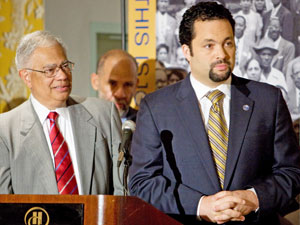
Cesar Perales, president of the Latino Justice/Puerto Rican Legal Defense and Educational Fund, left, and NAACP president Ben Jealous, call for fair
confi rmation hearings on Sonia Sotomayor at NAACP 100th Annual Convention in New York, July 11, and an end to racially charged remarks by Sen. Jeff
Sessions, ranking member of Senate Judiciary Committee. Photo: AP/Wide World Photos
|
Mr. Jealous, 36, the youngest CEO of the NAACP, asked reporters to be mindful that crises define the struggle of the times—which means the NAACP is concerned that too many Black men are out of work; too many students of color are going to inferior schools; too many people of color are in jail and too many people of color are dying of AIDS.
“We recognize the nature of the battles that we are fighting today has shifted,” he said.
Though the NAACP will continue the fight for enforcement of basic civil rights, its focus has expanded to human rights, Mr. Jealous explained.
“A civil rights battle is a battle to enforce the Constitution or the law as it stands. Well, there's no right to an education; no right to a job, no right to good health care; no right to anything in the criminal justice system than what we have right now,” Mr. Jealous told 5,000 delegates and invited guests during his July 13 address.
The road to victory in the human rights struggle is through organizing and the struggle will not be won with litigation alone, he argued.
The president of the NAACP also talked about tools to be used by the oldest civil rights organization as it moves forward: “We will invest in research. We will focus on technology, like Upload to Uplift.”
A new criminal justice initiative unveiled July 13, the Rapid Responder System, is available through the NAACP website at http://www.naacp.org/. The user-friendly online form allows people to send instant texts, e-mails, or video reports of police abuses to the association via cell phone.
“We applaud the NAACP on their anti-police brutality initiative. We are unified in our efforts. The rise in police brutality across the country is deplorable and we must text, e-mail, videotape and be vigilant and creative about ending the police misconduct crisis,” said Rev. Al Sharpton, of the National Action Network, told The Final Call in an e-mail.
“We have been able to strengthen our ability to craft our agenda” given the outpouring of acceptance of the new direction by the 5,000 delegates, from 1,700 branches and 400 youth chapters, observed Hilary Shelton, vice president for advocacy and director of the NAACP's Washington bureau. However, he would not say if police misconduct would become the cornerstone of the NAACP's work in the near future.
Delegates came from as faraway as Italy, Germany, Korea and Japan, according to Mr. Shelton. The organization is also “financially strong,” he said.
“We are trying to be smarter about everything,” Mr. Shelton added.
“Because of the hard work of all of you, membership is up in the field and online,” Mr. Jealous told convention goers.
Ed Josey, president of the Staten Island Branch of the NAACP, said foot soldiers in the field carry out the group's mandates on a day-by-day basis. “We get calls from people every day concerning racial prejudice and discrimination problems in the schools, or at work,” he said.
“We were here to talk about the future, but the same problems still exist – that tells us something,” Mr. Josey told The Final Call.
Mr. Josey, a second generation member and leader of the chapter, said police misconduct cases have become a big part of his local NAACP agenda. “We were able to force the Staten Island district attorney to indict two police officers for taking a Black teen to a wooded area and leaving him in only his underwear back in 2008. Because of our demonstrations and petitions they faced felony charges.”
However, days after the historic convention had ended, bloggers and neo-conservative talking heads were asking if the NAACP was still relevant, after the first Black president gave what some called a “conservative” speech that brought a standing ovation.
“I am aware of those blogs, and I respectfully disagree with their assessment of the president's speech. President Barack Obama knows the importance of the NAACP,” Mr. Shelton said.
“In other words, because Barack Obama won the presidency, we can now dismantle the civil rights protections and organizations that made it possible. Would they have made the same argument after WWII—that because the United States won, we could dismantle the military,” asked Julian Bond, chairman of the NAACP national board of directors.
“We don't hear calls for the elimination of the Anti-Defamation League because a Jewish woman sits on the Supreme Court or because a Jewish man is White House chief of staff. We don't hear calls for the elimination of the National Council of La Raza because a Latina is secretary of labor and another is poised to become a U.S. Supreme Court Justice.”
In his speech, President Obama admitted that racism remains a problem and that the NAACP still had work to do, even as he also called Black America to fight to overcome hurdles through personal responsibility and a focus on education.
“African Americans are five times as likely to see the inside of a prison, or more likely to suffer from diseases; these are some of the barriers of our times, which are very different from the earlier times,” the president noted.
Mr. Obama saluted the work of the NAACP. “I am here to say thanks to those great pioneers, ordinary people who did such extraordinary things,” he said.
Fighting today's racial disparities requires “the same commitment, that same sense of urgency to eradicate prejudice and discrimination” that the pioneers showed 100 years ago, said the 44th president and the first Black man to hold the nation's highest office. His address was televised so millions potentially had the opportunity to hear Mr. Obama's message.
As applause subsided, the president said, “Make no mistake the pain of discrimination is still being felt in America!”

News Search
Loading
Follow The FinalCall.com Networks



Join The FinalCall.com e-List


 Click Here Stay Connected!


For Email Marketing you can trust
Farrakhan Articles
- Unmasking Mr. Dershowitz
- Activists charge environmental poisoning and ‘silent homicide’ in San Francisco
- President spews more incendiary rhetoric as election draws closer
- Covid-19 and the divine chastisement of Florida
- The National Guard was deployed in Atlanta, what does this mean as shootings, violence plague other American cities?
- Our babies are dying, where are our friends?
- Hurling truth at Falsehood Nation of Islam responds to lies of Atty. Alan Dershowitz
- The impact of a universal message
- Police traffic stops in nation’s capital disproportionately target Blacks
- A Call to Action’ to address Covid-19 in Black Chicago
INSIDE STORIES AND REVIEWS
-

-

About Harriett ... and the Negro Hollywood Road Show
By Rabiah Muhammad, Guest Columnist » Full Story -

Skepticism greets Jay-Z, NFL talk of inspiring change
By Bryan 18X Crawford and Richard B. Muhammad The Final Call Newspaper @TheFinalCall » Full Story -

The painful problem of Black girls and suicide
By Charlene Muhammad -National Correspondent- » Full Story -

-

-

-

Exploitation of Innocence - Report: Perceptions, policies hurting Black girls
By Charlene Muhammad -National Correspondent- » Full Story -

Big Ballin: Big ideas fuel a father’s Big Baller Brand and brash business sense
By Bryan Crawford -Contributing Writer- » Full Story -
