The Final Call |
National News
Calif. lawmaker linked to Israeli spy inquiry
By Daniel Luban | Last updated: May 11, 2009 - 3:46:09 PMWhat's your opinion on this article?
WASHINGTON (IPS/GIN) - U.S. government investigators caught a prominent Democratic congresswoman discussing what is alleged to be a “quid pro quo” deal involving the American Israel Public Affairs Committee, Washington's powerful, hawkish pro-Israel lobby.
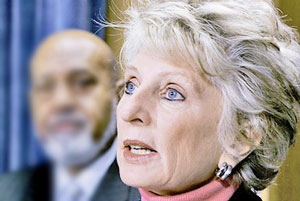
Representative Jane Harman (D-Calif.)
|
Perhaps even more notably, then-Attorney General Alberto Gonzales later halted an FBI investigation into Rep. Harman's actions because of Rep. Harman's political value as a defender of the George W. Bush administration's much-criticized warrantless wiretapping program, the CQ report states.
The Harman scandal's political repercussions appear to be growing, and it sits at the intersection of several controversial issues—among them, the influence of the “Israel lobby” on Capitol Hill, the complicity of top Democrats in Bush-era abuses, and the politicization of judicial proceedings under the Bush administration.
Rep. Harman has a reputation as one of the Democratic Party's foremost hawks, both on Israel-Palestine and on issues related to the “global war on terror.” She has long enjoyed a close relationship with AIPAC, and is scheduled to speak at the group's annual conference in May.
Allegations of a quid pro quo arrangement involving Rep. Harman and AIPAC are nothing new; Time magazine reported in 2006 that the FBI and Justice Department were investigating whether such a deal took place.
What was new in the recent CQ piece, written by reporter Jeff Stein on the basis of conversations with multiple senior national security officials speaking anonymously, were the claims that the deal had been recorded by the NSA wiretap and that Mr. Gonzales had squelched the investigation of Rep. Harman for political reasons.
In an April 20 online discussion, writer Stein stated the wiretap was court-approved and did not target Rep. Harman; rather, it was directed at the suspected Israeli agent with whom she was speaking.
Rep. Harman and her interlocutor were discussing the impending trial of Steven Rosen and Keith Weissman, two senior AIPAC staffers who had been fired and charged with violating the Espionage Act of 1917 for passing classified information to the Israeli government.
The Rosen and Weissman trials are scheduled to start this summer; Lawrence Franklin, the Pentagon staffer who passed them the classified information, pled guilty to conspiracy in 2006 and was sentenced to over 12 years in prison.
Rep. Harman was recorded saying that she would she willing to “waddle into” the AIPAC case to try to get the Justice Department to reduce its charges against Mr. Rosen and Mr. Weissman. In return, the suspected Israeli agent promised to help lobby Nancy Pelosi, at the time the House minority leader and now its speaker, to convince Rep. Pelosi to appoint Ms. Harman as chair of the House Intelligence Committee.
Rep. Harman at the time was serving as the Democratic ranking member of the Intelligence Committee, but had a testy relationship with Rep. Pelosi; she was ultimately passed up for the committee chair in 2006 in favor of Rep. Silvestre Reyes of Texas.
The identity of Rep. Harman's interlocutor is unknown, although most analysts are assuming that he or she had significant ties to AIPAC, which has traditionally been dominant in lobbying members of Congress on matters pertaining to Israel.
Haim Saban, a prominent Israeli-American businessman, has been frequently mentioned in the “blogosphere” as a possible suspect, but this identification seems primarily to have been based on the fact that Mr. Saban's name was mentioned in the 2006 Time magazine piece about Rep. Harman. So far no solid evidence has emerged to link him to the incident.
One anonymous source told the Atlantic's Marc Ambinder that Rep. Harman's interlocutor was a U.S. citizen.
AIPAC denied having participated in any wrongdoing in the Harman scandal. “AIPAC would never engage in a quid pro quo related to a federal investigation or any other federal matter,” spokesman Patrick Dorton said. “That is absurd.”
Rep. Harman's office also released a statement denying any wrongdoing.
“The CQ Politics story simply recycles 3-year-old discredited reporting of largely unsourced material to manufacture a ‘scoop' out of widely known and unremarkable facts,” the statement said.
“If there is anything about this story that should arouse concern, it is that the Bush administration may have been engaged in electronic surveillance of members of the congressional Intelligence Committees.”
Rep. Harman's concern about the Bush administration's surveillance policies is somewhat ironic, given that she was previously the strongest defender of the administration's warrantless wiretapping program among congressional Democrats—and that she appears to have avoided a federal investigation of her AIPAC ties only as a result of her permissive stance on wiretapping.
Rep. Harman had previously helped convince the New York Times not to report on the program, and after the newspaper finally decided to run the story, she blasted its editors for compromising U.S. national security.
Due to Rep. Harman's value in providing bipartisan cover for the administration's policies, Mr. Gonzales intervened with CIA Director Porter Goss to derail a pending FBI investigation of her, including a court-approved wiretap.
Related links:
Ex-U.S. Army engineer charged with spying for Israel (FCN, 05-05-2008)
New Israeli spy probe has a 30-year history, insiders say (FCN, 09-14-2004)
ADL: Censoring the Internet on behalf of Israel (FPP/Arabia.com 01-10-2001)

News Search
Loading
Follow The FinalCall.com Networks



Join The FinalCall.com e-List


 Click Here Stay Connected!


For Email Marketing you can trust
Farrakhan Articles
- Unmasking Mr. Dershowitz
- Activists charge environmental poisoning and ‘silent homicide’ in San Francisco
- President spews more incendiary rhetoric as election draws closer
- Covid-19 and the divine chastisement of Florida
- The National Guard was deployed in Atlanta, what does this mean as shootings, violence plague other American cities?
- Our babies are dying, where are our friends?
- Hurling truth at Falsehood Nation of Islam responds to lies of Atty. Alan Dershowitz
- The impact of a universal message
- Police traffic stops in nation’s capital disproportionately target Blacks
- A Call to Action’ to address Covid-19 in Black Chicago
INSIDE STORIES AND REVIEWS
-

-

About Harriett ... and the Negro Hollywood Road Show
By Rabiah Muhammad, Guest Columnist » Full Story -

Skepticism greets Jay-Z, NFL talk of inspiring change
By Bryan 18X Crawford and Richard B. Muhammad The Final Call Newspaper @TheFinalCall » Full Story -

The painful problem of Black girls and suicide
By Charlene Muhammad -National Correspondent- » Full Story -

-

-

-

Exploitation of Innocence - Report: Perceptions, policies hurting Black girls
By Charlene Muhammad -National Correspondent- » Full Story -

Big Ballin: Big ideas fuel a father’s Big Baller Brand and brash business sense
By Bryan Crawford -Contributing Writer- » Full Story -
