The Final Call |
World News
World food security slipping ever further away
By Carey L. Biron | Last updated: May 4, 2012 - 12:39:49 PMWhat's your opinion on this article?
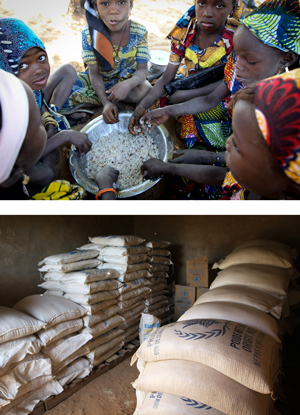
Prices at Niger’s food markets are spiking in the aftermath of a patchy harvest, causing concern among food security experts that many could soon go hungry. The failed harvest, brought on by drought, has driven prices up. According to the Government of Niger, some 750,000 people are severely food insecure, a number expected to reach one million by early 2012 as the country moves towards its traditional lean season in March and April. In response to the looming food crisis, WFP is aiming to support some 3.3 million people over the coming year with life-saving food assistance. Photos: UN Photo/WFP/Phil Behan
|
According to speakers at the launch of the World Bank-International Monetary Fund Global Monitoring Report 2012, on the sidelines of the Bank-IMF spring meetings, a lack of focus on agriculture and nutrition in development priorities could prove disastrous in the event of another spike in food prices.
The sudden rise in food prices in 2007-08 is thought to have brought the number of hungry people to more than one billion internationally. While food costs dropped in 2009 due to the international financial crisis, 2011 again saw record highs, brought about in part by variable weather conditions, mounting oil prices and the growing use of biofuels.
According to information released by the United Nations Food and Agriculture Organization in early April, food prices have continued to rise during the first three months of this year, and currently remain higher than during the crisis period of 2007-09. According to many observers, high food costs have become the “new norm.”
The social implications of fluctuations in food costs have been clear. The high cost of staple foods was a major driver behind the Arab Spring protests, for instance. Today, continued high food prices are fueling inflation worries across the globe, notably in India and China.
The Global Monitoring Report, which annually tracks development indicators, warns that critical policy buffers in low-income countries have yet to be rebuilt.
Although governments around the world did move to put food security atop the international agenda in 2011, those words have translated into little substantive action.
“The international community hasn’t followed through on any promises on making sure that prices are stabilized,” says Danielle Nierenberg, director of the Nourishing the Planet Program of the Worldwatch Institute, an environmental think tank here. “As the G8 and G20 meet, there is an opportunity to make sure that prices stabilize and that farmers are given the resources they need to survive.”
According to the GMR, international aid earmarked for agriculture, food and nutrition constituted just 10 percent of total pledges in 2010. In fact, Ms. Nierenberg says such low figures are relatively standard.
“For the past 30 years, there’s been a tendency to turn our backs on agriculture,” she told IPS. “One good thing to come out of the (food price) crisis has been new attention given to agriculture.”

News Search
Loading
Follow The FinalCall.com Networks



Join The FinalCall.com e-List


 Click Here Stay Connected!


For Email Marketing you can trust
Farrakhan Articles
- Condemning Belgium’s King Leopold II and enslavement, murder of 10 million Congolese
- Police brutality in the U.S., its roots and some views from the Motherland
- The Motherland’s powerful influence on Islam
- Seattle, Sudan and unlikely similarities in autonomous zones, calls to end repression
- Motherland stands with Black America’s fight against rampant police violence
- Pandemic impacts Africa’s informal cross border trade
- Ethiopian rabbis win court victory in Israel, but struggle continues for Africans in the Zionist State
- The history of Cuba’s unprecedented humanitarian work in Africa
- Pandemic shaping economic, social climate of East and Southern Africa
- African women farm majority of Africa’s food but own less than majority of land
INSIDE STORIES AND REVIEWS
-

-

About Harriett ... and the Negro Hollywood Road Show
By Rabiah Muhammad, Guest Columnist » Full Story -

Skepticism greets Jay-Z, NFL talk of inspiring change
By Bryan 18X Crawford and Richard B. Muhammad The Final Call Newspaper @TheFinalCall » Full Story -

The painful problem of Black girls and suicide
By Charlene Muhammad -National Correspondent- » Full Story -

-

-

-

Exploitation of Innocence - Report: Perceptions, policies hurting Black girls
By Charlene Muhammad -National Correspondent- » Full Story -

Big Ballin: Big ideas fuel a father’s Big Baller Brand and brash business sense
By Bryan Crawford -Contributing Writer- » Full Story -
