The Final Call |
World News
Big victory in Jamaica vote even shocks winners
By David McFadden Associated Press | Last updated: Jan 18, 2012 - 10:06:16 AMWhat's your opinion on this article?
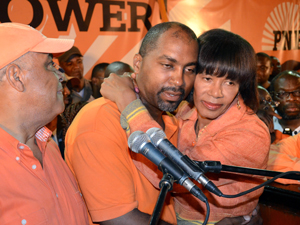
A photo made available on Dec. 30 shows Jamaican Presidency candidate and leader of the Partido Nacional Popular (PNP) party, Portia Simpson Miller (R), celebrating her victory in the elections with supporters in Kingston, Jamaica, Dec. 29. Others are not identified. The opposition People’s National Party, led by former Premier Portia Simpson Miller, won Jamaica’s general elections, preliminary results showed late Dec. 29. The party had already won more than half the 63 seats up for grabs in the elections on Dec. 29. Photo: EPA/RUDOLPH BROWN
|
“We were very confident but the results certainly exceeded our most optimistic scenarios,” said Peter Phillips, a veteran lawmaker who led mobilization efforts for the opposition People’s National Party.
In the Jan. 29 election, voters threw out the Jamaica Labor Party after four years in power and delivered a landslide triumph to the main opposition whose campaign tapped voter disillusionment across the island.
A final vote count is expected in coming days, but preliminary results give former Prime Minister Portia Simpson Miller’s party a dominating 41-22 seat advantage in the House of Representatives. A little more than half of the eligible 1.6 million voters cast ballots.
Previous to the election, the Labor party held 32 seats in Parliament, compared to 28 held by the People’s National Party.
With the island’s biggest newspaper predicting a comfortable Labor win and most opinion polls putting the two clan-like parties in a virtual dead heat, the sizable margin was a stunning defeat for Prime Minister Andrew Holness, who has led Jamaica for just two months.
In a sign that voters were chastening Mr. Holness’ Labor party, they dumped some of his top Cabinet ministers, including National Security Minister Dwight Nelson and Energy Minister Clive Mullings, who lost their bids for re-election to the Parliament.
Paying off the nation’s punishing debt has long forced the government to scrimp on services, and the electorate remains deeply divided.
Mr. Phillips said the People’s National Party knew something was up about two weeks before the election when the turnout of amped-up opposition supporters at campaign events grew in advance of a largely unpopular Christmas week vote.
The Labor party chose Mr. Holness, 39, as prime minister in October when predecessor Bruce Golding resigned amid anemic public backing. Mr. Phillips said it was a shrewd move to switch leaders, but the strategy failed to give Labor much traction. And despite promising otherwise, Mr. Holness failed to convince voters that he was an agent of change.
“What happened was that Holness was unable to persuade the electorate that the Labor Party was a different party under him,” said Mr. Phillips, noting that the prime minister nominated Mr. Golding’s Cabinet as his own, with a few minor tweaks.
Mr. Holness displayed a serious-minded, preachy style on the campaign trail that appeared to alienate some of his party’s supporters. Jamaican voters historically focus on personalities, and blatant patronage has long been at the crux of politics.
Born to working-class parents in the impoverished city of Spanish Town, Mr. Holness regularly said he was an example of what Jamaica could hope to accomplish as a country. Such rhetoric apparently did little to inspire swing voters.
Public remarks by Labor officials suggested no hand-wringing over Mr. Holness’ leadership after the election loss. The outgoing prime minister was gracious in defeat Dec. 29, wishing the People’s National Party success for the sake of the country.
Ms. Simpson Miller has pledged to lift debt-wracked Jamaica out of poverty and create jobs but has offered few specifics. Some political analysts have said her party has been more focused on winning elections than effectively serving the population.
The People’s National Party led the island for 18 years before its 2007 election loss, and Mr. Holness argued during the campaign that it mismanaged the economy, causing a steady devaluation of the Jamaican dollar and cutting deeply into the purchasing power of most wage earners.
Mr. Phillips acknowledged that there will be “no quick fixes” for Jamaica, but he said Ms. Simpson Miller is committed to quickly extending a relationship with the International Monetary Fund and pushing job creation and economic growth. He predicted a jobs program at the heart of the party’s platform will bear fruit.
Jamaican economist Norman Girvan said the immediate challenge facing Ms. Simpson Miller’s government will be boosting the country’s chronically sputtering economy and re-establishing a pact with the IMF, which last year approved a $1.27 billion (.81 billion pounds) loan to help the struggling Caribbean island.
“The room to maneuver is limited. A fresh austerity package is a virtual certainty,” Mr. Girvan said. “Getting sustainable growth remains the number one challenge for Jamaica.”

News Search
Loading
Follow The FinalCall.com Networks



Join The FinalCall.com e-List


 Click Here Stay Connected!


For Email Marketing you can trust
Farrakhan Articles
- Condemning Belgium’s King Leopold II and enslavement, murder of 10 million Congolese
- Police brutality in the U.S., its roots and some views from the Motherland
- The Motherland’s powerful influence on Islam
- Seattle, Sudan and unlikely similarities in autonomous zones, calls to end repression
- Motherland stands with Black America’s fight against rampant police violence
- Pandemic impacts Africa’s informal cross border trade
- Ethiopian rabbis win court victory in Israel, but struggle continues for Africans in the Zionist State
- The history of Cuba’s unprecedented humanitarian work in Africa
- Pandemic shaping economic, social climate of East and Southern Africa
- African women farm majority of Africa’s food but own less than majority of land
INSIDE STORIES AND REVIEWS
-

-

About Harriett ... and the Negro Hollywood Road Show
By Rabiah Muhammad, Guest Columnist » Full Story -

Skepticism greets Jay-Z, NFL talk of inspiring change
By Bryan 18X Crawford and Richard B. Muhammad The Final Call Newspaper @TheFinalCall » Full Story -

The painful problem of Black girls and suicide
By Charlene Muhammad -National Correspondent- » Full Story -

-

-

-

Exploitation of Innocence - Report: Perceptions, policies hurting Black girls
By Charlene Muhammad -National Correspondent- » Full Story -

Big Ballin: Big ideas fuel a father’s Big Baller Brand and brash business sense
By Bryan Crawford -Contributing Writer- » Full Story -
