The Final Call |
World News
More soldiers, more murders in Mexico's drug war
By Emilio Godoy | Last updated: Jul 12, 2010 - 11:57:48 AMWhat's your opinion on this article?
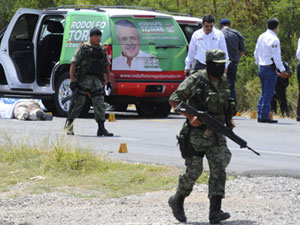
Army soldiers guard the crime scene after a candidate for governor of the state of Tamaulipas, Rodolfo Torre, was ambushed by unidentified gunmen near the city of Ciudad Victoria, Mexico, June 28. Gunmen assassinated the front-running candidate and several of his aides in what Mexico's President Felipe Calderón called an attempt by drug gangs to sway local and state elections. Photo: AP/WideWorldPhotos
|
In the study “Statistical Analysis and Visualization of the Drug War in Mexico,” published in June on his blog, Diego Valle analyzes the homicide rates in some Mexican states and links them to the military operations against the Mexican drug cartels.
“When Calderón decided to send the army across the entire country, it destabilized the balance of power among the cartels. Some were weaker and the Sinaloa cartel played its cards very well,” Mr. Valle, an information systems and database analysis expert, told IPS.
After taking office in December 2006, President Calderón, of the right-wing National Action Party (PAN), ordered the deployment of thousands of soldiers and police to the regions hardest hit by the actions of drug-trafficking groups.
The first phase of this campaign was in the southwestern state of Michoacán, Mr. Calderón's birthplace, where he sent 4,500 troops. Several criminal groups have been fighting over that territory because it serves as an important drug route to the U.S. border.
“The violence depends on other factors, such as readjustments in the power of the criminal organizations. It hasn't been generated by the participation of the armed forces in the fight against crime,” said Mario Cruz, expert from the public Autonomous National University of Mexico.
Initially, the war on drugs was successful: the national homicide rate for 2007 saw a decline, and the rate in Michoacán state dropped 40 percent compared to the previous year, according to Mr. Valle, who made his calculations using government data.
A total of about 95,000 soldiers have been deployed, extending to other Mexican states. Since 2006, drug-related murders have surpassed 22,000, according to official figures. Of that sum, legal authorities have investigated more than 1,000.
More than 120,000 people have been arrested for their alleged ties to organized crime. Less than 10 percent of that total is believed to belong to the Sinaloa cartel, commanded by Joaquín “El Chapo” Guzmán, whose fortune reaches $1 billion, according to the U.S. financial magazine Forbes.
The Federal Preventive Police have refused to reveal the number of civilians without ties to the drug trade that have been killed in the clashes.
“Before the government began its anti-drug war, each cartel had its own protection networks and lived in peace with their rivals and with the government,” commented Mr. Valle.
“They knew that if they started an open war against another cartel, they had a lot to lose. They were equally powerful, or at least powerful enough to defend their territories. So they did not have many incentives to go to war amongst themselves,” he said.
The first joint military operations in 2006 and 2007 reduced the murder rates in Michoacán and the southern state of Guerrero, but the northern states of Chihuahua, Nuevo León and Durango, and southeastern Veracruz saw increases in homicides and attacks from the Sinaloa cartel in their bids to take over the drug-trafficking routes of rival groups.
Since 2006 the alliances amongst the drug cartels have been short-lived, which means those who were partners yesterday do not know if they will be rivals tomorrow.
“It is not ideal for the armed forces to attack this problem, but because there is no other institution to take it on, this was the option chosen. The policing entities are poorly trained, or have not been set up to fight the corruption of organized crime,” said Autonomous National University of Mexico expert Cruz.
The Mexican government lays the blame for the current levels of violence on the battle to control the routes for transporting and distributing the illicit drugs—primarily cocaine, marijuana, heroin and methamphetamine—to the lucrative U.S. market of drug users.
But Durango, the northwestern state of Sonora and Veracruz did not need military intervention, according to the statistical comparison.
“The expansion of military operations beyond Michoacán and Guerrero was unnecessary. Given the resulting increases in violence it is doubtful that involving the army was the appropriate solution,” said Mr. Valle.
Mexican and international human rights defense organizations have criticized the military action, arguing that the troops are not trained to fight drug trafficking. For example, under army presence, the homicide rate in the northern border city of Ciudad Juárez increased 400 percent from 2007 to 2008, while the national increase was 65 percent, with the highest incidence in areas where the drug cartels were fighting each other for control.

News Search
Loading
Follow The FinalCall.com Networks



Join The FinalCall.com e-List


 Click Here Stay Connected!


For Email Marketing you can trust
Farrakhan Articles
- Condemning Belgium’s King Leopold II and enslavement, murder of 10 million Congolese
- Police brutality in the U.S., its roots and some views from the Motherland
- The Motherland’s powerful influence on Islam
- Seattle, Sudan and unlikely similarities in autonomous zones, calls to end repression
- Motherland stands with Black America’s fight against rampant police violence
- Pandemic impacts Africa’s informal cross border trade
- Ethiopian rabbis win court victory in Israel, but struggle continues for Africans in the Zionist State
- The history of Cuba’s unprecedented humanitarian work in Africa
- Pandemic shaping economic, social climate of East and Southern Africa
- African women farm majority of Africa’s food but own less than majority of land
INSIDE STORIES AND REVIEWS
-

-

About Harriett ... and the Negro Hollywood Road Show
By Rabiah Muhammad, Guest Columnist » Full Story -

Skepticism greets Jay-Z, NFL talk of inspiring change
By Bryan 18X Crawford and Richard B. Muhammad The Final Call Newspaper @TheFinalCall » Full Story -

The painful problem of Black girls and suicide
By Charlene Muhammad -National Correspondent- » Full Story -

-

-

-

Exploitation of Innocence - Report: Perceptions, policies hurting Black girls
By Charlene Muhammad -National Correspondent- » Full Story -

Big Ballin: Big ideas fuel a father’s Big Baller Brand and brash business sense
By Bryan Crawford -Contributing Writer- » Full Story -
