The Final Call |
World News
Has Nigeria become a failed political entity?
By Saeed Shabazz -Staff Writer- | Last updated: Apr 19, 2010 - 11:49:21 PMWhat's your opinion on this article?
|

|
The mandate of the special advisor is to collect information that may suggest genocide, which would be used by the Security Council to decide if severe measures such as sanctions or sending a UN force into the area are necessary. Hundreds of Nigerians have been killed in 2010 during clashes that are blamed on Muslim and Christian conflicts.
The Security Council's concerns seem to run parallel to recent discussions outside of the world body that Nigeria may be headed towards “failed state” status. A failed state is one in which the central government has lost control over significant areas of the country.
“Nigeria is not a failed state, it's an artificial state, which was never meant to be a nation state,” said Dr. Leonard Jeffries, professor of Africana Studies at the City University of New York and vice president of the World Afrikan Disapora Union. “Nigerians have done well to keep their nation together,” he said. “The Europeans, specifically the British created this artificial entity knowing it could not sustain itself.”
In 1897, the British declared the Niger River area a “protectorate” under the Royal Niger Company Territories. The name Nigeria was applied in the latter 19th century by the British administrator to the region, Barron Lugard.
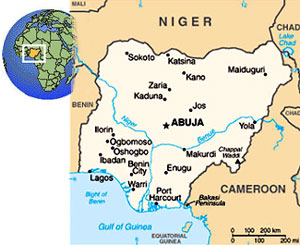
In 1960, the 36 states that make up the Federal Republic of Nigeria were granted their freedom by the British. Abuja was named the capital. Nigeria is the home of 250 ethnic groups and 4,000 dialects, the largest ethnic groupings are the Hausa, Igbo, and Yoruba. Nigeria is bordered by Benin to the west, Chad and Cameroon to the east, Niger to the south, and of course the Gulf of Guinea. It is the most populous African nation with 150 million people.
On March 19, the New York-based Council on Foreign Relations issued a position paper titled “Nigeria in Turmoil” which called the West African nation an “important strategic partner” for U.S. interests in Africa. The position paper warned that the ethnic violence in Jos “again drew international attention” to the increasingly unstable Nigerian “political situation.”
Foreign Policy magazine in a July 2009 article asked if Nigeria was in danger of becoming an extremist haven, because the largest oil producing nation in Africa was inching up on the “Failed States Index” with a worsening security situation, comatose electricity system, non-existent infrastructure and mediocre leadership.
“It is true, the government must do something about the electricity issue,” said UN correspondent Addullahi Shuaibu of the Nigerian News Service. Mr. Shiaibu had just returned from his Northern Nigerian home and he told The Final Call that he had to buy gas for the generator that was needed to keep the lights on. “This is another example of oil revenues not translating into good services,” he said.
“There are social tensions; the political infrastructure has almost collapsed, there has been a cut in the food and water supply. The government refuses to inject new ideas into its thinking and actions. We are headed towards being a failed state because government mechanisms are not working,” insisted Mr. Shuaibu.
In 2005, the CIA released a report by the U.S. National Intelligence Council predicting the break up of Nigeria by 2015, which is in stark contrast to the CIA saying in 2008 that Nigerian government had begun “showing the political will to implement the market-oriented reforms urged by the International Monetary Fund such as modernizing the banking system; curbing inflation by holding down wage demands; and resolving regional disputes concerning distribution of earnings from the oil industry.”
In February, the U.S. assistant secretary of African Affairs at the State Dept., testifying before the Senate Foreign Relations Subcommittee on African Affairs, stated: “Nigeria is one of the two most important countries in sub-Saharan Africa—the U.S. goal is to help Nigeria fulfill its potential as a regional leader.”
The same diplomat, Johnnie Carson, speaking March 26 before the House Committee on Foreign Affairs Subcommittee on African and Global Health, shared the thinking of the Obama administration on the country. He said that “although political progress has been made, Nigeria still faces significant challenges and uncertainty.”
The fact that Nigeria is the fifth largest supplier of oil to the U.S. means that its political stability is “vital to the economic welfare of the U.S.,” said Gerald LeMelle, executive director of the Washington, D.C.-based think tank Africa Action. Nigerian oil exports to the U.S. are worth an estimated $38 billion a year.
“Sure, Nigeria is going through some growing pains,” Mr. LeMelle told The Final Call. “People are jockeying for the resources, and fighting to protect their interests.” What is happening in Jos are people are getting frustrated and taking ownership of their resources, he said.
Some observers say the Jos crises, and all ethno-religious strife, hinges on the failure of leadership and bad government at all levels. Nigerian-based organizations like the Nigerian Institute of Social and Economic Research and the Nigerian Institute of International Affairs say the violence from 2004 to now is due to “deep-seated” irregularities within Nigerian society and Jos' geographic position as the “de-facto fault line” that separates Muslims and Christians makes it a prime area for disruptions.
Analyst Emira Woods, co-director of Foreign Policy in Focus at the Institute for Policy Studies in Washington, says that it is important not to minimize the religious aspects of the recent violence in Jos, but she insists the main issue is a fight for resources. “It doesn't take much to set things off these days,” she said.
Settlers in the area, who are the mainly Muslim Hausa/Fulani, feel that they have limited access to state programs such as scholarships, bank loans and employment, explained Ms. Woods. “The indigenous Christian population feels that the settlers are encroaching on their ancestral lands. In the oil-rich Niger Delta people want an improvement to their living standards; where most people are living in mud huts, some only a few feet away from oil wells. They lack electricity and indoor toilets. They have no hospitals, no running water, and no schools; and there is unemployment,” Ms. Woods told The Final Call.
Ezekial Macham of the Alliance of Nigerian Organizations of Georgia agrees with Ms. Woods, that religious and ethnic differences do not play a prominent part in the recent violence. “It is an economic issue,” he told The Final Call. “Most of the youth don't have jobs. Why is that happening in an oil-rich state such as Nigeria?” he asked rhetorically. Mr. Macham said that a coalition of Nigerian organizations in the U.S. known as the Association of Northern Nigerian, which is comprised of Muslims and Christians are formulating a position paper on the current situation in Nigeria.
Dr. Jeffries offered a stark prediction: “Africa was destined to be a place of failed states; and for Nigeria it is suffering through the colonial legacy left by the British.” He also isn't sure more analysis will change what he sees coming.

News Search
Loading
Follow The FinalCall.com Networks



Join The FinalCall.com e-List


 Click Here Stay Connected!


For Email Marketing you can trust
Farrakhan Articles
- Condemning Belgium’s King Leopold II and enslavement, murder of 10 million Congolese
- Police brutality in the U.S., its roots and some views from the Motherland
- The Motherland’s powerful influence on Islam
- Seattle, Sudan and unlikely similarities in autonomous zones, calls to end repression
- Motherland stands with Black America’s fight against rampant police violence
- Pandemic impacts Africa’s informal cross border trade
- Ethiopian rabbis win court victory in Israel, but struggle continues for Africans in the Zionist State
- The history of Cuba’s unprecedented humanitarian work in Africa
- Pandemic shaping economic, social climate of East and Southern Africa
- African women farm majority of Africa’s food but own less than majority of land
INSIDE STORIES AND REVIEWS
-

-

About Harriett ... and the Negro Hollywood Road Show
By Rabiah Muhammad, Guest Columnist » Full Story -

Skepticism greets Jay-Z, NFL talk of inspiring change
By Bryan 18X Crawford and Richard B. Muhammad The Final Call Newspaper @TheFinalCall » Full Story -

The painful problem of Black girls and suicide
By Charlene Muhammad -National Correspondent- » Full Story -

-

-

-

Exploitation of Innocence - Report: Perceptions, policies hurting Black girls
By Charlene Muhammad -National Correspondent- » Full Story -

Big Ballin: Big ideas fuel a father’s Big Baller Brand and brash business sense
By Bryan Crawford -Contributing Writer- » Full Story -
