The Final Call |
Business & Money
Who is Watching the Supercommittee???
By Julianne Malveaux -Guest Columnist- | Last updated: Nov 18, 2011 - 10:12:53 AMWhat's your opinion on this article?
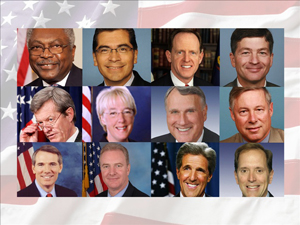
Photos: MGN Online
'According to Politico, more than 200 lobbyists are pressuring Supercommittee members to protect their interests.' |
I suppose the thinking behind creating the Supercommittee, composed of six Democrats and six Republicans, is that 12 minds are better than 535. The size of the committee may also make it easier for lobbyists! According to Politico, more than 200 lobbyists are pressuring Supercommittee members to protect their interests.
Julianne Malveaux
|
For now, it appears that the Pell Grant of $5,500 for low-income students remains intact. However, the Supercommittee is looking for places to cut, and they are looking everywhere. Absent lobbyists, we will all have to lobby to protect the students who do not have the resources of the health care industry, legal associations, and those other 200 crowding Capitol Hill. To be sure, many of the Supercommittee members are committed to education. Congressman James Clyburn (D-SC), for example, is the only Congressional Black Caucus member on the Supercommittee. He has long been a friend of Historically Black Colleges and Universities (HBCUs). He is likely to find allies among other Democrats on the Supercommittee. However, will they be able to withstand both the Republican zeal to reduce the size of government or the automatic triggers that will take place if the Supercommittee can’t find compromise?
It is also likely that Title III funding, which is specifically targeted to HBCUs, will be on the chopping block. Earlier this month, several UNCF presidents met with members of the Congressional Black Caucus to talk about ways that Title III money can be protected. Those who care about HBCUs must lobby not only CBC members and Congressional Representatives in areas where HBCUs are located, but also any and every voter, especially those on the Supercommittee. The Committee is co-chaired by Senator Patty Murray (D-WA) and Congressman Jeb Hensarling (R-TX), and includes Senators Max Baucus (D-MT), John Kerry (D-MA), John Kyle (R-AZ), Rob Portman (R-OH), and Pat Toomey (R-PA). Congressional representatives include Xavier Becerra (D-CA), Jim Clyburn (D-SC) and Chris Van Hollen (D-MD), Fred Upton (R-MI) and David Camp (R-MI).
When you scour the headlines, you won’t find much written about the Supercommittee, even though they are in the throes of meetings and negotiations. We can expect Democrats to protect entitlements and Republicans to resist tax increases, and these are sure ingredients for an impasse. When the Supercommittee was formed critics from both the left and the right talked about the possibility of it deadlocking, as in order to attain a simple majority, somebody will have to cross party lines. The last time we faced a budget impasse, we ended up with a reduction in our Standard and Poor’s rating from AAA to AA+. When it cut our nation’s rating, S&P said their prognosis for the long-term fiscal health of the United States was “poor.”
The Supercommittee may well be out of the news, but it should not be off our radar screen. The dozen members are making decisions that will have long-term consequences. They may well decide to tackle aspects of our tax structure, and they will certainly decide to cut some, if not all, federal programs. We must all ensure that the Supercommittee will not reduce the deficit on the backs of the poor and the powerless, especially our students.
(Julianne Malveaux is President of Bennett College for Women in Greensboro, NC.)

News Search
Loading
Follow The FinalCall.com Networks



Join The FinalCall.com e-List


 Click Here Stay Connected!


For Email Marketing you can trust
Farrakhan Articles
- Locked Out And Going Out Of Busines$
- $349 billion Covid-19 small business program short-changes businesses of color
- Stimulus stunts and secret tricks
- Hope, doubts about $2.2 trillion spending bill
- Economic uncertainty and instability amid Covid-19 crisis
- Affordable housing for low wage workers a remote dream
- Corporate shutout: Black professionals face prejudice and exclusion in America
- Richest 1% in U.S. surpassing wealth of middle class: Report
- Falling Black homeownership remains a problem
- Student debt disrupts chances, widens racial wealth
INSIDE STORIES AND REVIEWS
-

-

About Harriett ... and the Negro Hollywood Road Show
By Rabiah Muhammad, Guest Columnist » Full Story -

Skepticism greets Jay-Z, NFL talk of inspiring change
By Bryan 18X Crawford and Richard B. Muhammad The Final Call Newspaper @TheFinalCall » Full Story -

The painful problem of Black girls and suicide
By Charlene Muhammad -National Correspondent- » Full Story -

-

-

-

Exploitation of Innocence - Report: Perceptions, policies hurting Black girls
By Charlene Muhammad -National Correspondent- » Full Story -

Big Ballin: Big ideas fuel a father’s Big Baller Brand and brash business sense
By Bryan Crawford -Contributing Writer- » Full Story -
