[INDEX |
NATIONAL
|
WORLD
|
PERSPECTIVE
|
COLUMNS
|
MONEY
|
ENTERTAINMENT
|
HEALTH
|
TECH
|
LETTERS
|
SUBSCRIBE]
FinalCall.com News
World News
War dead total in Iraq may be an undercount
By Ahmed Ali and Dahr Jamail
Updated Jun 19, 2008 - 10:37:00 AM
BAQUBA, Iraq (IPS/GIN) - The real death toll in Iraq is far higher than even the highest declared in official counts, many Iraqis say.
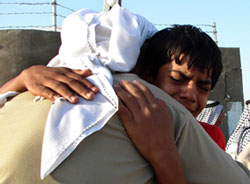 |
| An Iraqi youth weeps as he embraces his relative outside the morgue of a hospital in Baghdad, early Oct. 10, 2006. Photo: WISSAM AL-OKAILI/AFP/Getty Images |
“The U.S. military benefits from hiding the real totals,” said a political analyst who declined to give his name because of the atmosphere of fear within Iraq. “And the Iraqi government is a puppet of the Americans, so their figures are ridiculously low, as well.”
A Baquba resident, who also asked to remain nameless, said: “All people know that a large number of bodies are dropped into the Diyala River. I was kidnapped and taken to a village called Huwaider, which is completely Shia and located on the Diyala River. Sunnis there are killed and dropped in the river by militiamen, but I was freed by the U.S. Army.”
“People in all the villages on the river have gotten used to seeing bodies floating in the river,” he added.
Nongovernmental studies have offered varying estimates of the country’s death toll.
A study by doctors from the Johns Hopkins School of Health in conjunction with Iraqi doctors from al-Mustanceriya University in Baghdad estimated the number of excess deaths as a result of the occupation at above 655,000. The study was published in the British medical journal The Lancet in October 2006.
Just Foreign Policy, an independent organization “dedicated to reforming U.S. foreign policy” offered an updated total of 1.2 million at the time of this writing.
On Sept. 14, 2007, Opinion Research Business, an independent polling agency located in London, produced a figure of 1.2 million deaths as a result of the invasion.
These estimates are higher than any official figures from Iraq, but they do take the reported official figures into account.
The report published in The Lancet did not take into account many circumstances of death, according to residents in Baquba, the capital of Diyala province.
An officer at the directorate-general of police for Diyala province said the number of dead is impossible to calculate exactly.
“When the new security plan began in Diyala, some of the arrested militants confessed that they were burying bodies,” the officer said. “Some of them led us to the places where they buried the bodies. We found hundreds by digging in the areas that are a stronghold of the militants, and sometimes in the gardens of the houses they were living in, or in a place nearby.”
An eyewitness at the Baquba morgue spoke with IPS on condition of anonymity.
“I was looking for my relative who was kidnapped and then killed, and I saw an ambulance moving the dead who were killed by militants,” he said, “I asked the driver about these bodies. He said the Iraqi army found them in houses and in holes dug within the houses. I also saw a skeleton among the bodies.”
Many believe that the number of the dead is higher than these studies reflect also because the lack of access to areas controlled by militias and other fighters prevents police and army personnel from finding and collecting bodies.
“These militia strongholds have prevented access to police for over two years now,” said Ali Hussein, a local vegetable seller. “Dozens and sometimes hundreds were kidnapped every day and taken to the militants’ strongholds. People heard nothing about thousands of them. Even today, thousands of families know nothing about their loved ones because they were not found in the morgue.”
A policeman, speaking on condition of anonymity, said: “We were moving the bodies from the main streets of the city through patrols. A body that may have been dropped in the street is a message for people. They dropped it purposely. But these are only a few; the bodies of most we believe were killed were never found.”
Other officials also offered bleak assessments.
“Hundreds of families come to the provincial office every day to ask about their loved ones who were kidnapped; they do not know whether they are dead or alive,” an employee at the governor’s office said. “Often the Iraqi army finds records of the dead from the militants through their confessions. Every week there are new lists of names of those who were killed by the militants. People come to find out whether their loved ones are dead, in order to stop searching.”
New burial grounds are found often, and the dead are usually not recorded. Many residents say farmers commonly find bones in their fields.


