
Political requiem for a Black conservative
by Earl Ofari Hutchinson
�Guest Columnist�
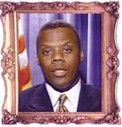 (FinalCall.com) -- The torrent of praise from President Bush,
Republican Congressional leaders and, political pundits for retiring
Oklahoma Congressman J.C. Watts sharply contrasted with the deafening
silence from Black Democrats and civil rights leaders. This should
hardly surprise. After his election from a predominantly White district
in 1994, the former University of Oklahoma football player immediately
threw down the gauntlet to Black Democrats. He proudly and defiantly
declared that he would not join the Congressional Black Caucus. (FinalCall.com) -- The torrent of praise from President Bush,
Republican Congressional leaders and, political pundits for retiring
Oklahoma Congressman J.C. Watts sharply contrasted with the deafening
silence from Black Democrats and civil rights leaders. This should
hardly surprise. After his election from a predominantly White district
in 1994, the former University of Oklahoma football player immediately
threw down the gauntlet to Black Democrats. He proudly and defiantly
declared that he would not join the Congressional Black Caucus.
In one of the keynote addresses at the Republican Convention in 1996,
Watts also threw down the gauntlet to the old-line civil rights
leadership. He punched all the favorite conservative hot button items,
championing family values and self-help, and hammering welfare and
public housing.
Watts goaded Black Democrats and civil rights leaders a year later
when he branded them "race hustling, poverty pimps." It was dirty mud
slinging and the reaction was swift and harsh.
A somewhat chagrined Watts and his Republican mentors rushed to do
damage control and claimed that he was not talking about any one leader
or point-of-view in particular. He was, and anyone even remotely
familiar with the political battle between liberals and conservatives
that bothered to think about his words knew who they were and what they
represented, i.e., liberalism and Blacks.
But Watts was not entirely skating on thin political ice in his
attacks on traditional Black leaders. He knew that a growing number of
Blacks publicly call themselves conservative, and many more Blacks
privately agree with some, most, or all of Watts� political beliefs. He
also knew that the old-line civil rights leadership was in crisis. They
have been relentlessly battered and bruised during the 1980s and 1990s
by conservative politicians and a lack of meaningful leadership. Much of
the public has turned hard-nosed against increased civil rights
protections and more social programs. These leaders have felt the
criticism and wrath of many Blacks that are mortally disillusioned with
two party politics.
Watts and the Black conservatives believed that time and the
abyss-like financial pockets of Republican conservatives were on their
side and that more Blacks would eventually rally to their banner and
they could then step over the shattered pieces of the old Black
leadership to become the new Black leaders. The problem Watts had is
that while many Blacks do brand traditional Black leaders as the
purveyors of "plantation politics" and call them sycophants of the
Democrats, the majority of Blacks are and will continue to be Democrats.
In every presidential election in the past three decades, Blacks have
given the Democratic presidential nominee more than 80 percent of their
vote.
They did the same for Al Gore in 2000. During that same time period,
the Republican Party has systematically rejected Blacks. While Bush made
much about inclusion before and during the presidential campaign, the
Florida vote debacle still leaves a strong odor in the nostrils of many
Blacks. They still accuse him of cheating Blacks out of thousands of
votes in Florida and hijacking the White House. Since then he has been
stone silent on expanded hate crime laws, the mandatory sentencing laws,
opposed any discussion of reparations, and has renewed his call for
school vouchers which Black Democrats and civil rights leaders
universally condemn.
Then there�s Bush�s shabby treatment of the Congressional Black
Caucus. Though they are all solid Democrats, they have repeatedly asked
for a meeting with him to try to work out some of the colossal
differences between them.
And Bush has repeatedly put them off. This is a terrible mistake.
Despite their past hostility toward him, for the past 30 years, Black
officials have fought tough battles in the courts and Congress for
voting rights, affirmative action, school integration, an end to housing
and job discrimination, and police abuse. Many Blacks regard them as
their political voice, and they expect Bush to recognize and respect
them also.
And though a number of Blacks have reservations, if not outright
doubts, about affirmative action, welfare, and other government social
programs they are not prepared to dump these programs. Watts and Black
conservatives are; but in the process they offer nothing better. Their
politics and leadership are just as "plantation" as the Black Democrats
they gleefully lambaste.
That was apparent in how Republican leadership used Watts. He was a
good mouthpiece for conservative causes and a visible symbol of their
supposed commitment to racial inclusion. But how much real power did he
really have within his own party? And that is the ultimate dilemma of
Watts and Black conservatives. They make useful symbols but not much
else.
Blacks will continue to reject their Republican pitch, and
Republicans will continue to reject them as equal partners in power.
Watts ultimately realized this, and he did the only thing that he could
do,� he left.
(Earl Ofari Hutchinson is an author and columnist. Visit his news and
opinion web site at: www.thehutchinsonreport.com.)
|


