A Christian view of Minister Farrakhan's Peace
Mission
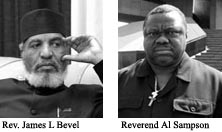 [Editor�s note: Reverends James L. Bevel and Al Sampson
worked closely with Dr. Martin Luther King Jr. during some of the
most turbulent years of the Civil Rights Movement. Rev. Bevel
organized and directed many of King�s grassroots strategies and Rev.
Sampson is one of a few pastors ordained by Dr. King. Both pastors
accompanied Min. Louis Farrakhan during his recent Peace Mission to
Africa and the Middle East.
[Editor�s note: Reverends James L. Bevel and Al Sampson
worked closely with Dr. Martin Luther King Jr. during some of the
most turbulent years of the Civil Rights Movement. Rev. Bevel
organized and directed many of King�s grassroots strategies and Rev.
Sampson is one of a few pastors ordained by Dr. King. Both pastors
accompanied Min. Louis Farrakhan during his recent Peace Mission to
Africa and the Middle East.
They recently sat down with Final Call editor James Muhammad
in separate interviews to discuss the Peace Mission.]
Final Call News (FCN): What do you think your role was as
a Christian minister traveling with the delegation?
Rev. Al Sampson (RAS): I�ve always felt that the three great
religions come out of the soil of Mother Africa. This trip taught me
more as a minister and pastor and as a theologian, that maybe all
these books were one. I saw my role as the other side of Minister
Farrakhan. We were really trying to say that our God is one and so
are we. We were trying to say that beyond these religious barriers,
there is human suffering and pain that occurs because of the
decisions by delinquents on the issue of how do men and women sit
down and reason things together.
For me, it was a religious pilgrimage because we were really
trying to say that for the New Millennium, men and women of all
cultures and all religious beliefs have got to stay at the table and
talk these things out rather than take innocent peoples� lives and
destroy them under the machinations of war.
It became a mission for me because I was in Syria walking on the
straight street that�s in the Bible, and I go to the oldest church,
St. Anias, in Christianity and preached from the pulpit inside the
church in Damascus, Syria. And as a preacher for 46 years in the
ministry, I�ve always talked about the Damascus road experience of
Paul. But it became not a period at the end of the sentence for me,
because at the other end of the straight street, around the corner,
was the tomb of Bilal, who was the slave who called the (Muslims to)
prayer.
I got a chance to spend a moment with the spirit of two men: one
who utilized military exploitations by killing Christians, and the
other one who received cultural and economic exploitation as a
slave, but both men became Ambassadors for God. And they gave our
mission purpose because Minister Farrakhan and myself, we kind of
see ourselves as Ambassadors of God to say to some forces, stop
economically exploiting our people, and to say to other forces to
stop militarily exploiting our people.
Rev. James Bevel (RJB): To observe, to investigate and to
purify myself so I can adequately interpret the overriding
constitutional violations, because in order to have peace, you have
to know what is the constitutional violation. If the constitutional
violation is never corrected, there cannot be peace. If my feet are
hurting because my shoes are too small and I don�t correct the fact
that the shoes are too small, then I will always be complaining
about the bunions and the corns on my feet because of the too small
shoes. The constitutional violations aggravate the spirit of the
people. It�s like a volcano or an earthquake.
FCN: What were the constitutional violations in this case?
RJB: In the Palestinian/Israeli case, both are trying to
attain a just outcome that will lead to peace without using the
principles and methods that will produce such outcome. In the Iraq
situation, it is the criminal behavior on the part of
select-President George Bush that is an extension of the criminal
behavior perpetrated against the Africans brought here to develop
the country, the continued criminal behavior perpetrated against the
Native Americans until they had virtually murdered them and taken
their land, the criminal behavior against the Vietnamese people, the
criminal behavior against the people of Panama and the continued
criminal behavior against the African American people. When people
have something like a commodity or raw material that the American
people want, they (America) always conjure something up, based on
their racism, and then they step outside the law and conjure social
schemes to justify in the eyes of the American people the murder and
robbing and killing of people under the pretense of some great good.
That�s what�s going on with Iraq. An observation of that was born
out of the statements that Bush made giving the CIA license to
murder (Saddam Hussein) and then going to the United Nations to get
exemption from International Criminal Court proceedings if they
engage in criminal behavior against people. That is the most serious
problem.
FCN: How do you feel the Muslims in the area received you
as a Christian?
RJB: The grand mufti of Syria demonstrated that they don�t
have a sense of separation of Christians and Muslims. That�s a
projection from the division in Americans. They respect all the
people of the Book. If you are a practitioner, they will deal with
you on what principles you practice. If you practice Christian
principles, they will experience you as a Muslim because if you take
Jesus� position of loving and serving God and God only, then
although you are a Christian in culture, functionally you are a
Muslim because you will honestly address the health, interests and
rights of others as you do your own.
RAS: I feel that the Muslim community has open arms,
especially the times when the Minister talked about our religious
and historical experience of my opening up the doors of my church to
the Nation of Islam. And then he compared that to the people of the
Book and how Jesus said in the New Testament that there are some
voices which are called by his name, and then going back and picking
up the story of the Muslims that came into Ethiopia to the church
and those kinds of flashbacks. You read the history and then you are
a part of the history that you are reading about really made me feel
comfortable. I felt that they felt comfortable with us being there
because we were not "infidels" and we represented a new brand of
Christianity and not a European understanding of Christianity.
FCN: What do you mean when you say, they understood that you
didn�t represent the
European brand of Christianity?
RAS: I got the impression that they understood because the
African in America has had a long history of struggle. I never got
the feeling that people in the Middle East were blind to that. A lot
of them have been to America and their relatives or friends have
been to America and they saw, and knew, and understood our struggle.
I think that at least some of them have a greater appreciation for
who we were because of the Minister�s own credibility and his
ability to explain why we have to do this Christian/Muslim
relationship, because we are talking about a new religious force
inside of our community that if other cultures adopted this idea of
no barriers, no boundaries, it would give a whole lot of societies a
greater level of communication with each other.
FCN: What do you think was accomplished by the mission?
RJB: The success became evident by today�s paper where the
Saudis said, "Not in our backyard." (Referring to Saudi Arabia�s
refusing the U.S. to launch an attack on Iraq from their soil.) It
was a divine mission. The first night that we arrived, the Minister
was negotiating with the Al Jazeerah (television) staff and they
asked him to come and be interviewed, and he agreed. Nobody knew Mr.
Bush was coming on to give his fallacious plan on how to bring about
peace, which was really an attack on the Palestinian people and a
promotion of the Israelis. And [the Minister�s] response created a
climate of reasoning and a climate of dignity and a climate of
truth, not a climate of vindictiveness or fear. It was very
effective in terms of strengthening the resolve of people. Sometimes
a man needs to hear an intellectual position even though he may be
straddling the fence or in fear, but when a state of reasoning can
be brought, then the fear does not overtake people. The Minister was
very effective in getting those leaders of the Middle East to start
thinking in terms of government and principles of law. rather than
being stampeded like the U.S. Congress was stampeded.
RAS: One, the Minister is regarded as a world leader that can
influence foreign policy on a grand scale. Dr. King once said that
sometimes it�s more important for him to threaten that he�s coming
than for his actual arrival. And even though we did not get into
Israel, the Knesset met as a legislative body to discuss a Black man
(Farrakhan) having the moral authority to be involved in foreign
policy. The State Department had to have meetings and say, "here is
a Black man in foreign policy." I thought that was noteworthy.
On the other side of the coin, the Arab community really listened
to Minister Farrakhan and can trust his voice. The Minister was
showing the contradictions. And I guess the secret in the Minister�s
ministry is that he talks to the leaders, but it is the masses of
people across the water that really listen to him. And the
leadership in these countries is very frightened at not being able
to keep the people asleep. He wakes them up and he makes them
responsible. And then they, in turn, hold the leadership
responsible. So when Bush gave his speech, the Minister was right
there at Al-Jazeerah television and he was the first person, Black
or White, that was in the center of history to give a response,
which sent a signal to all of the Middle East countries and to send
a response back home that (Israeli Prime Minister Ariel) Sharon,
theoretically, could have wrote Bush�s speech and the PLO didn�t get
anything. I think that was a major accomplishment.
Also, I don�t get the feeling that the [U.S.] was talking until
the Minister started speaking. I think there was a cloud of fear
from the White House to everybody�s house to sit down and shut up
and let Ashcroft and Bush and Condoleezza Rice and that cabal run
everything. The Minister�s position about, "I am a citizen of the
United States but I am a citizen of the world and I don�t like the
way my country is going and I don�t like the way my world is going"
brought all of us into a universality of the Power of God. I think
the Minister�s impact on the world stage was a clear picture that
not only are Blacks going to get involved in foreign policy, but
also we have an actual agenda to return to America and wake up the
people.
FCN: Before you went on the Mission, did you have any
preconceived thought of what you wanted to personally contribute or
something you really wanted to do?
RJB: The missing factor is the ill response of the American
citizens. The way the world is set up, there are two power pockets.
The superior force pocket is the United States government, military
establishment and the men who run that. But the second most powerful
force is the American citizen�s supreme power as responsible
citizens. Superior force is not equal to supreme power. When I start
thinking about our irresponsibleness as American citizens to let
Bush run around threatening to kill people and manipulating and
intimidating, and buying and blackmailing and getting UN Security
Council members to go along with him, having a right to kill people
and that the government should not have to go to criminal court, we
can�t live with that. When we lived in the South, the KKK came in
and killed people and nobody could checkmate them and they didn�t
have to go to court. Now he wants to go around the world killing
mainly non-white leaders with the sanctions of the United Nations
behind him. That reality bothered me more than anything else. I will
not leave these conditions to my children. My work is to bring the
citizens� supreme power to bear on this military force that racist
White people who have taken over America�s military establishment is
attempting to impose on the whole world.
FCN: What about the issue of Zimbabwe and the land issues of
southern Africa?
RJB: That�s when I really felt the pain of this (newspaper
headline) "CIA gets license to kill?" and how the western papers try
to make Libyan President Gadhafi look strange and foolish by the way
they write. It�s interesting because they use the same adjectives to
describe him as they describe Minister Farrakhan. When we got to
Zimbabwe and met President Mugabe and he explained the history and
the land reform issue, that 4,000 Whites had 36 million or so acres
of land, way out of proportion to their need, and when he was
pressed by his own people to take responsibility to make sure
justice was brought to this, how America and Britain and the Zionist
press use this game to tar and feather people. They have two games
they play: They kill men�lynching. And they tar and feather people,
that is to make such an ugly image of people that everybody becomes
afraid of the man and agree that they can kill the man. I became
very aware of the need to dismantle this racist Bush regime and
government.
RAS: Zimbabwe became kind of a sacred stop. In 1976, we had
the ZANU/ZAPO Movement at our church. So here I am 27 years later,
sitting at the table with President Mugabe and visited the grave of
(revolutionary) Joshua Nkomo who were our idols in the revolution of
the land question. We created the phrase in Chicago "the land grab,"
which is what has happened to Black urban renewal, which meant Negro
removal. We got a great lesson on how revolutionary movement was
occurring all over the South, especially in that South African wing
of Africa.
And it was a mirror reflection of what�s happening to just about
every single Black city in America that a Black mayor sits on.
There�s 530 Black mayors and in all these major urban cities, there
is a land grab going on, where they will allow us to have the
political side of the economy, but not give us access to the
economic side of the economy. Which is why, by the way, why I feel
Gadhafi is one of the strongest men and a visionary kind of man. He
understood that watching us on CNN with the Million Man March that
we needed a block of capital, not a grant, but a billion dollars in
order to build schools and highways and grocery stores to develop
our own economy.
The fear in Zimbabwe with the European and the American forces is
that if he becomes successful, it sends a rippling effect to
Namibia, to Botswana, Swaziland and then ultimately South Africa.
The diamond is of no value except the value that a group of men have
placed on it. And our brothers and sisters, especially the brothers,
have to go 100 miles down in the ground for the gold and diamonds
with no benefits, just for people in European and American
countries.
FCN: What are your thoughts on the war on terror, particularly
how it has taken a Christian/Muslim crusade?
RJB: When you are not truthful, not constitutional, and
you�re not democratic, then you cannot mobilize and motivate and
organize people based on truth. So you have to use hate or fear,
which means you have to tell lies. That�s what they�re doing. [Bush]
rules by lies, hate and fear. That then becomes a game to solidify
his forces. He had no popularity; he is not a duly-elected
president; he had no support; he had no program. He cannot advance a
policy of intelligent education. He cannot advance a policy of
constitutional development. He cannot advance a policy of family
life, because a man cannot invite you to where a man is not. So the
only thing he can do is play on the hatred, greed and disease of the
racist White people and the fear of Black people. He�s playing this
terrorist game in order to create a context where he can rule
America as an empire. They think they are going to manipulate the
American people and world population into some kind of bamboozled
high dictatorship that they run. And the Jews that are backing them
up in this kind of foolishness will wind up just like the Jews in
Hitler�s Germany because they are going to violate so many people by
their acquisition and manipulation of the economies that the world
is going to turn on them again. The Jews didn�t just wind up in that
predicament in Hitler�s Germany. They were reaping something they
had sown. I would advise them to study that so they can live in the
world with people as brothers and sisters.
RAS: I think a lot of media critics have been very
disingenuous towards the Minister�s mission and Rev. Jackson�s
mission because there is a direct tie-in between the domestic agenda
of rebuilding our cities, our bridges, our highways and our schools,
and at the same time taking those monies out of the domestic budget
and putting them into the military budget. I was trying to remember
what moment in history did we ever have $23 billion given to the
Department of Housing, to the Department of Labor. But $23 billion
just got voted in the other day for Homeland Security in order to
create a domestic surveillance system to invade the privacy of
people.
We are worried that brothers and sisters in America might end up
with uniforms to go to the Middle East and fight on that soil or to
the Sudan to fight on that soil. I think that we are having a 9-11
in our own lives because things that we held dear are now being
blown up and torn up by the Bush administration�the right to speak,
the right to communicate, the right to dissent is now being blown up
by the terroristic legislative acts of Bush and company. He�s on
this mission to keep a war economy going so he has to keep finding
some enemies to keep perpetuating a war economy so that Boeing
aircraft and McCalister, etc., can keep building bombs and building
planes.
We have a great opportunity if we can ask God to continue the
strength of Minister Farrakhan. I think we have a great opportunity
to mobilize our people again. I�m going to be very much concerned
about October 16th. It�s the seventh year of our anniversary of the
Million Man March, and I think it would be a great opportunity
before the November elections to put the whole issue of America in
the issue of violence on the National Agenda, which then will have a
rippling effect on the international agenda.
FCN: Thank you.
Photo Credit: Kenneth Muhammad



