
Social commentary and Black rap
Why can Eminem blast the 'system' but PE can't?
by Eric Ture Muhammad
�Staff Writer�
(FinalCall.com) -- Can White
artists make social commentary and get airplay while Black artists
can�t? Why is Black music reserved to booty shakin�, thuggery and
promoting the latest drugs and alcohol?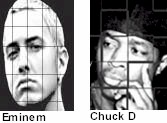 These aren�t new questions for
socially conscious consumers of Black entertainment. But the recent
controversy over the "censoring" of rap group Public Enemy�s (PE) latest
video raises the questions even higher.
These aren�t new questions for
socially conscious consumers of Black entertainment. But the recent
controversy over the "censoring" of rap group Public Enemy�s (PE) latest
video raises the questions even higher.
"Artist have choices," Black CEO Karen Mason of Atlanta-based Destiny
Talent Agency told The Final Call. "They can decide what they
will sing, act and do. They are fully responsible for all that they do.
And we as the consumer must challenge them.
"I mean, how does someone go from the rhetoric of the Five Percent
Nation (Busta Rhymes) to hawking Courvoisier (liquor)�for free�without
us holding him or her accountable," she charged. "I don�t think it so
much a matter of being radical or not. It�s really about right and
wrong. Is it right to peddle Courvoisier to our youth? Is it right to
drop inferences and outright commercials for ecstasy (drugs), oral sex
and immoral behavior to our youth?"
A strong public outcry from hip hoppers everywhere successfully
forced Music TeleVision (MTV) to reverse its decision to ban PE�s latest
video, "Gotta Give the Peeps What They Need." The song is from
their latest album, "Revolverlution." The video and lyrical
content speaks to the freeing of political prisoners Mumia Abu Jamal and
Imam Jamil Abdullah Al-Amin, the former H. Rap Brown. Both are former
Black Panther Party members.
MTV originally refused to air the video unless all references to Mr.
Abu Jamal were censored out. It was their position that the content was
glorifying "cop killers." Both Mr. Abu Jamal and Imam Al-Amin were
convicted of the killing of law enforcement officers. Both maintain
their innocence and say the actions taken against them is part of a
government conspiracy.
"I deal with media hijacking and the uses of technology on us," Chuck
D told The Final Call in an exclusive interview. "The key, and I
learned this from (researcher) Steve Cokely and others, is to try to
talk about new sciences and new effects without sounding like I�m
talking Japanese to our people.
"It�s not the fact that MTV turned down the video and we�re trying to
get the video played. I don�t give a damn. I make music to make a
statement," he said.
After public outcry intensified via e-mail petitions, editorials,
commentaries and the threat of boycott and demonstrations outside of
MTV�s New York studios, MTV reconsidered its position and recently
announced plans to air the video free of censorship.
Apparently, the issue of freeing Black U.S. political prisoners�which
America claims not to possess�is a larger threat to White-owned music
stations and labels than social issues raised by White artists like
Eminem. The PE track, although tremendously popular in underground hip
hop communities across the world, is hardly heard on radio or seen on
music television stations. The same goes for other dominant Black male
artists in hip hop like Kam and Dead Prez.
"The Honorable Elijah Muhammad said that if you know better, you will
do better," PE member Professor Griff told The Final Call. "But
that�s a two-fold process. First you have to know, and then you have to
do. And these artists�they know. They just refuse to take a proactive
stance, maybe from fear of losing some fans or some money. They are up
in the millions of dollars anyway, but they fear the loss, when they
could at any time be sued for the foolish things they do and lose it all
anyway," he said.
On the other hand, Eminem is in heavy rotation as he calls for the
removal of the Bush administration. In his latest effort, "The Eminem
Show," on the track called "Square Dance," the White artist
rambles strong social commentary against the U.S. government�s war
policies, terror and Mr. Bush.
"There is indeed music that offers more than booty-shaking, sex,
drinking and drugs," commented WAOK radio talk show host Chris Askew in
Atlanta. "The problem is, we collectively seem to ignore it. It�s easy
to say we are being force-fed this music, but why do we consume it in
such volume?
"One way to address this problem is to understand that we have power
in how we determine to spend our money. We are the trendsetters. Each
and every dollar does count. I will never knock an artist for the work
he or she creates and I will always defend their right to create it, but
we are lacking balance in the presentation of the arts across the
board," he said.
"The bottom line is artists have to become more aware of what is
going on in our community," said Kenya Jordana James, the 13-year-old
editor-in-chief of Blackgirl magazine. "A lot of these artists
are not in touch with the pulse of their community. It�s all Hollywood
now. At the same time, there are artists who are saying something. There
are artists out there who are conscious of what is going on � and we
need to support them."
Some of those artists the youth hear, she said, are the group Nappy
Roots; singers India.Arie, Lauryn Hill, Erykah Badu and reggae artist
Damian Marley.
"We need an inner-anarchy," Chuck D said, suggesting that people in
the industry should organize and go after individuals in these
corporations and make them personally accountable.
"That will start something," said Chuck D. "You got people who remain
anonymous that make decisions on programming for millions of people and
nobody knows who the hell they are. If you start naming the names,
social security numbers, names of their kids, the schools they�re at,
they�ll start running like roaches with the lights on, and they will
start making more conscious decisions. We would have knocked away the
corporate veil and force them to make statements as individuals.
"You know my name and you attack me and you hide under the corporate
name of MTV. If you can know my name and attack what we do as a group, I
have and the people have the right to know you�first, middle, last
name�and everything about you, like the corporations have on all of us,"
he said.
|


