 CHICAGO (FinalCall.com)�Rep.
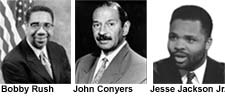
John Conyers (D-Mich.), the "dean" of the Congressional Black Caucus (CBC),
said the Black legislators "are all opposed to any proposed invasion of
Iraq" that is being pursued by the Bush administration.
CHICAGO (FinalCall.com)�Rep.
John Conyers (D-Mich.), the "dean" of the Congressional Black Caucus (CBC),
said the Black legislators "are all opposed to any proposed invasion of
Iraq" that is being pursued by the Bush administration.
He also said the group would welcome a briefing by the Honorable
Minister Louis Farrakhan on findings from his recently completed Peace
Mission to the Middle East and Africa, including a visit to Iraq.
"We don�t have a policy to articulate to you," Rep. Conyers said July
20, referring to lack of a united statement by the CBC on Iraq, "but we
oppose any extension of war on terror" that operates outside the
parameters of the U.S. Constitution, Rep. Conyers said, adding that only
Congress can declare war against a nation.
Rep. Conyers made the statement to reporters during a press
conference at the Rainbow/PUSH Coalition headquarters at the start of
the organization�s 5-day annual convention, which will include a speech
by former President Bill Clinton. Reps. Bobby Rush and Jesse Jackson
Jr., both Chicago Democrats, flanked Rep. Conyers.
"Minister Louis Farrakhan should be in before the Congressional Black
Caucus to give a briefing on his trip to share information from an Iraqi
perspective of what�s taking place in the Middle East," Rep. Jackson
told The Final Call.
"He should be seeking a meeting with (Rep.) Dennis Hassert (D-Ill.)
and (Rep. Dick) Gephart (D-Mo.) for they are policymakers in Congress.
[Min. Farrakhan] can be very helpful to our government at this time,"
Rep. Jackson said.
Rep. Marcy Kaptur (D-Ohio) put her position more bluntly.
"The U.S. has a schizophrenic policy toward Iraq," she said, adding
that the U.S. international policy is "completely destructive."
"We have to work with the world community to build bridges, not
walls," she said. "We should be looking for different ways to show a
better face."
The last president to launch a campaign against Iraq in an attempt to
overthrow President Saddam Hussein was George Bush Sr. He was successful
in securing financing from other countries and appealed to other nations
to use their airspace en route to Iraq.
For the past 11 years, the tiny Muslim nation has been under strict
no-fly zones along its northern and southern borders. With the UN
embargo and sanctions still in place, the country cannot purchase or
build conventional arms to secure its own sovereign airspace.
Recently, under the banner of unfinished business, current President
George W. Bush vowed to use "all tools" at his disposal to topple the
Iraqi president. Speaking to reporters, Mr. Bush reiterated, "It�s a
stated policy of this government to have regime change. And it hasn�t
changed. And we�ll use all tools at our disposal to do so."
In London, July 12-14, the Iraqi National Coalition Military
Alliance, a London-based confederation of Iraqi opposition groups that
has received $97 million in U.S. aid, arranged a meeting of former
military personnel living in exile. More than 200 people attended to
discuss how to topple Pres. Hussein. U.S. State Department spokesman
Richard Boucher confirmed during a news briefing in Washington that
personnel from the American embassy in London also attended the
gathering.
"We do support this kind of broad-based conference of Iraqi military
people," Mr. Boucher said. "We think it�s a useful tool in helping the
Iraqi community move closer to the goal of a better future for the Iraqi
people after Saddam Hussein."
The United Nations on July 16 was accused by Iraq of caving in to
U.S. pressure. Hans Blix, executive chairman of the UN Monitoring,
Verification and Inspections Commission, after two days of talks with UN
Secretary-General Kofi Annan and others, failed to reach agreement on
the return of arms inspectors, who left Iraq in December 1998 on the eve
of a U.S.-British bombing campaign over Iraq�s alleged refusal to
cooperate with the weapons experts.
Checking on Iraq�s alleged efforts to build weapons of mass
destruction is key to suspending UN sanctions imposed after Iraq invaded
Kuwait in 1990, sparking the Gulf War. Iraq wants the 12-year-old
sanctions lifted before it allows the inspectors to return.
"It was very clear that America pushed the head of the inspection
team, Mr. Hans Blix, to obstruct discussions and hinder a joint
agreement," Iraq Foreign Minister Naji Sabri told reporters after
returning from the talks in Vienna. Mr. Sabri said Mr. Blix refused to
hold "meaningful discussions" on what had and had not been achieved
during years of UN inspections in Iraq from May 1991. "Without agreeing
on what has not been achieved, we cannot go forward," he said.
Mr. Bush, concentrating on covert action, signed an order earlier
this year directing the CIA to increase support to Iraqi opposition
groups and allowing possible use of CIA and Special Forces teams to
assassinate the Iraqi president.
"No one has substantiated the allegations that Iraq possesses weapons
of mass destruction or is attempting to acquire weapons of mass
destruction. It has been nothing but rhetorically laced speculation, not
hard facts that have been presented by either the United States or Great
Britain to back this up, and until they provide hard facts, there is no
case for war," said former UN weapons inspector Scott Ritter during a
recent television interview on MSNBC.
"Let�s remember, Saddam Hussein didn�t kick the inspectors out. The
U.S. ordered the inspectors out 48 hours before they initiated Operation
Desert Fox�military action that didn�t have the support of the UN
Security Council and which used information gathered by the inspectors
to target Iraq," said Mr. Ritter.
Another former United Nations humanitarian coordinator in Iraq said
July 12 that he has seen no evidence that weapons of mass destruction
are currently being produced in Iraq. Hans Von Sponeck said he saw
plants there producing pesticides, insecticides and material for
hygienic purpose in households, on a very minor scale.
But as for the Al-Dora and Al-Fallouja plants, two facilities
destroyed by U.S. bombs and alleged by Western intelligence to be back
in operation, "There is nothing. It is in the same destroyed status. It
is a totally locked up institution where there is not one sign of a
resumed activity," he said in a televised interview, voicing concerns
about the "power of disinformation."
Mr. Von Sponeck resigned in 2000 to protest against UN sanctions
against Iraq.
Regarding his UN resignation, Mr. Von Sponeck chimed, "When you
discover you are associated with a policy that makes life worse for
people in the long run, you can�t be associated to that."