by Askia Muhammad
White House Correspondent
 THE WHITE HOUSE (Finalcall.com)
-- If President George W. Bush gets
his promised war with Iraq, it will be a war like no other war in
American history and he appears to be preparing the public for the
possibility that he might launch an attack without any international
support.
THE WHITE HOUSE (Finalcall.com)
-- If President George W. Bush gets
his promised war with Iraq, it will be a war like no other war in
American history and he appears to be preparing the public for the
possibility that he might launch an attack without any international
support.
"The policy of my government, our government, of this administration
is a regime change�for a reason," Mr. Bush told reporters during an Oval
Office meeting with Jordan�s King Abdullah. "Saddam Hussein is a man who
poisons his own people, who threatens his neighbors, who develops
weapons of mass destruction. And I will assure His Majesty like I have
in the past, we�re looking at all options, the use of all tools."
King Abdullah, in the past, has called the plan against Iraq
"somewhat ludicrous."
Ironically, Mr. Bush�s war would be unique because it would not be a
defensive war in response to manifest aggression by Iraq, members of the
Senate Foreign Relations Committee were told during two days of hearings
from several panels of decidedly pro-Bush administration authorities
Aug. 1-2. Still, they managed to fashion together a thin veil of
"respectability" with which to cloak their seemingly unattractive war.
The U.S. must act quickly before Pres. Saddam Hussein gets any
stronger, most of the experts who were chosen in consultation with the
administration testified. Unlike past wars into which the U.S. was
drawn, Mr. Bush�s pending war against Iraq will be to impose U.S.
policies long ago approved by Congress and a government whose leaders
are chosen by the U.S. on the people of Iraq.
"The U.S. would be initiating a war�not without provocation�but not
in the same way we�ve been drawn into any wars in the past," Samuel
Berger, former national security adviser to Pres. Bill Clinton,
testified at the conclusion of hearings.
 "The U.S. may well be moving toward launching the first major
pre-emptive war in its history," Prof. Anthony Cordesman, a fellow at
the Center for Strategic and International Studies testified. "If the
U.S. does go to war with Iraq, it will not be because of any recent
Iraqi act of aggression, evidence of Iraqi terrorism, or Iraqi
conventional military build-up�the UN embargo has deprived Iraq of any
major arms imports for more than a decade."
"The U.S. may well be moving toward launching the first major
pre-emptive war in its history," Prof. Anthony Cordesman, a fellow at
the Center for Strategic and International Studies testified. "If the
U.S. does go to war with Iraq, it will not be because of any recent
Iraqi act of aggression, evidence of Iraqi terrorism, or Iraqi
conventional military build-up�the UN embargo has deprived Iraq of any
major arms imports for more than a decade."
"It will go to war because Iraq is led by a tyrant who is too
dangerous to tolerate by containment and because he is covertly building
up his capability to deliver chemical and biological weapons." Dr.
Cordesman, a Pentagon consultant said.
But no matter what the action might be called by the Pentagon, the
U.S. military would be employed to execute "The Iraqi Liberation Act," a
law passed by Congress and signed into law by Mr. Clinton in 1998. U.S.
forces would launch a "pre-emptive" strike in order to affect that
"regime change" in Baghdad removing Iraqi President Saddam Hussein from
power.
Inside the Pentagon itself, according to published reports, experts
are divided over the wisdom of U.S. direct intervention, versus
continuing to employ the various military "containment" strategies that
have virtually eliminated Iraq�s real military threat.
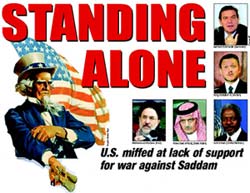
In addition, America�s international allies are staunchly opposed to
aggression against the Muslim nation.
German Chancellor Gerhard Schroeder and Foreign Minister Joschika
Fischer said a more important issue to resolve is the broader Middle
East conflict, obviously referring to the Palestinian/Israeli conflict.
"To talk now of having to push through a change in government in
Baghdad with a military intervention, that�s a false assessment of
priorities," Mr. Fischer reportedly said in a television interview.
During an Aug. 3 meeting in Tehran, foreign ministers of Iran and
Saudi Arabia said both countries opposed a strike on Iraq.
Iranian President Mohammad Khatami told visiting Saudi Foreign
Minister Saud al-Faisal that "all countries of the world, especially
neighbors of Iraq" should encourage Pres. Hussein to observe UN
resolutions in order to "remove any grounds for aggression."
Prince Saud expressed opposition to "any U.S. military attack on Iraq
or any other Muslim or Arab countries," Iran�s state-run radio said.
Turkey, where the U.S. dispatches air patrols of a no-fly zone over
Iraq and protects ethnic Kurds, is trying to dissuade the U.S. from
attacking Iraq.
"We are carrying out both military and political preparation. On the
other hand, if there is a military operation that affects Turkey, like
it or not, it will affect us. So we are trying to deter the United
States administration from a military operation," Prime Minister Bulent
Ecevit said recently.
Even UN Secretary General Kofi Annan, in an interview in the pan-Arab
daily Al-Hayat newspaper, said plans for attacking Iraq were
unwise, and that seeking a "regime change" in Baghdad was outside UN
policies. The UN Security Council had not endorsed any such move, Mr.
Annan was quoted as saying.
A few liberal senators have launched what they call a "national
dialogue" about war with Iraq. Last April, the Judiciary Committee held
hearings on the constitutional questions about Mr. Bush�s authority to
launch a war without an official congressional declaration. Later,
Senators Dianne Feinstein (D-Calif.), and Patrick Leahy (D-Vt.)
introduced a resolution opposing the use of force against Iraq without
congressional authorization.
The Foreign Relations Committee hearings were intended to help inform
the American people, according to Committee Chair Joseph Biden (D-Del.),
yet he never questions the basic rightness or wrongness of the U.S.
policy of choosing the leaders of other countries.
"President Bush has stated his determination to remove Saddam from
power, a view many in Congress share," Sen. Biden said opening the
hearings. "If that is the course pursued, it matters profoundly how we
do it, and what we do after we succeed."
Absent from these Foreign Relations Committee hearings were
dissenting experts�like former U.S. Attorney General Ramsey Clark; Scott
Ritter; or Hans Von Sponeck, a former UN assistant secretary general who
headed the Iraqi "Oil For Food" program until he resigned to protest
continued sanctions. (See interview in Final Call, Vol. 21 No. 43.)
Such witnesses would dissent from the policy advocating U.S. military
action to remove a foreign official whom the U.S. doesn�t like.
"Sen. Joe Biden is running a sham hearing," former Chief UN Weapons
Inspector Scott Ritter said in a statement. "It is clear that Biden and
most of the congressional leadership have preordained a conclusion that
seeks to remove Saddam Hussein from power regardless of the facts, and
are using these hearings to provide political cover for a massive
military attack on Iraq.
"These hearings have nothing to do with an objective search for the
truth, but rather seeks to line up like-minded witnesses who will
buttress this predetermined result. This isn�t American democracy in
action, it�s the failure of American democracy," he said.
Mr. Ritter explained to The Final Call: "Congress passed the
Iraqi Liberation Act in 1998, without the kind of meaningful dialogue
that needs to take place before implementing such a law, which puts
forward as the law of the land, the concept of overthrowing Saddam
Hussein."
"If, as promised so many times, the U.S. does attack Iraq to
overthrown its government, it will be the most notorious, arrogant and
contemptuous violation of the Charter of the United Nations, the
Nuremberg Charter and international law yet experienced," Mr. Clark said
in a July 29 letter to members of the UN Security Council, and to the
Senate Foreign Relations Committee.
"Only absolute power, unrestrained by any rule of law or standard of
human decency, openly taunts an intended victim as President Bush has
taunted Iraq," Mr. Clark�s letter said.
"How in the world do you justify the deaths of tens of thousands of
children because you don�t like their leader?" Ambassador Edward Peck,
former Chief of Mission, U.S. Embassy, Baghdad, told The Final Call,
when asked about the affect of U.S.-led sanctions in place against Iraq
for the last 11 years.
"You�re not killing Saddam Hussein, you�re killing Iraqi children.
Which flies in the face of everything we stand for, everything we
profess around the world goes right out the window when it involves
Saddam Hussein, because he�s not a nice guy.
"I don�t think the world is going to forgive us for doing what we�re
talking about doing, without justification, without proof," said Mr.
Peck.
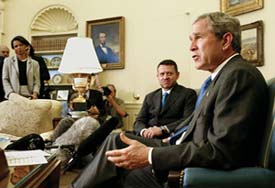
Photo:
President Bush and Jordan's King Abdullah answer a
question from the media as National Security Advisor Condoleeza Rice
looks on during their Oval Office meeting at the White House Aug. 1.
King Abdullah is one of many international leaders who are in
disagreement with Mr. Bush on the issue of war on Iraq. Photo: AFP



