Countdown
against death
Activists mount
emergency campaign to save Texas death row inmate
by Nisa Islam Muhammad |
 As
activists face a countdown toward the June 22 execution of Texas death
row inmate Shaka Sankofa, formerly known as Gary Graham, more questions
about capital punishment have emerged�and his defenders are kicking
their campaigns to save Mr. Sankofa�s life into high gear. As
activists face a countdown toward the June 22 execution of Texas death
row inmate Shaka Sankofa, formerly known as Gary Graham, more questions
about capital punishment have emerged�and his defenders are kicking
their campaigns to save Mr. Sankofa�s life into high gear.
Gov. George W. Bush, who has the power to commute Mr.
Sankofa�s sentence, has stuck by his state�s record on executions.
He argues no innocent person has ever been put to death and that the
state allows proper access to court for appeals.
Mr. Sankofa has exhausted the appeals process.
"American capital sentences are persistently and
systematically fraught with serious error. Indeed, capital trials
produce so many mistakes that it takes three judicial inspections to
catch them, leaving grave doubt whether we do catch them all,"
counters Professor James S. Lieberman of the Columbia Law School. His
study, released June 12, found when courts finally did review cases,
seven out of 10 times errors were serious enough to overturn death
sentences.
The Columbia Law School study examined every capital
conviction and appeal between 1973 and 1995 (nearly 5,500 judicial
decisions). During that 23-year study period, the overall rate of
prejudicial error in American capital punishment system was 68 percent,
he found.
Errors that led courts to overturn capital sentences
were not mere technicalities. The three most common errors: incompetent
defense lawyers (37 percent), prosecutorial misconduct, often the
suppression of evidence of innocence (19 percent) and faulty
instructions to jurors (20 percent).
"Let�s look at the evidence. Gary Graham (Shaka
Sankofa) owned a 22-caliber pistol. Police officers said ballistics
tests on the bullet that killed the man Graham was convicted of killing
did not match Gary Graham�s gun. And this new evidence was never
presented at trial," said Rep. Jesse L. Jackson (D-Ill.).
The Sankofa conviction was based largely on the
testimony of a single eyewitness, whose credibility is questionable, no
physical evidence links the death row inmate to the killing and his
counsel was ineffective, said Rep. Jackson and other death penalty
opponents.
Ronald Mock was Mr. Graham�s attorney at the time
of his conviction. Attempts to reach Mr. Mock were referred to his
attorney Mike Moriarty, who was also unavailable for comment at press
time. Mr. Mock�s record of handling cases includes by his own account
in the Washington Post "about 16 or 17" clients that
have gone to death row and at least five have been executed. He called
no witnesses in the Graham case and relied on his closing argument to
win the case.
"Short of DNA evidence�which is simply not
available in most cases�it is difficult to imagine more compelling
evidence of actual innocence than the evidence in Gary Graham�s (Sankofa�s)
case," said Professor Lawrence C. Marshall, legal director of the
Center on Wrongful Convictions.
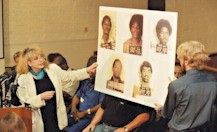
Dr. Elizabeth Loftus, the nation�s leading expert
on the fallibility of eyewitness testimony, said the eyewitness
procedures employed in the Sankofa case were seriously flawed. "The
photo array that police showed to the key witness in the case was
suggestive because Graham (Sankofa) was the only man shown in the array
who matched key aspects of the victim�s initial description," she
said.
"Then, in a lineup the witness viewed the
following day, Graham was the only person whose picture also had been in
the photo array. We know beyond a doubt that mistaken eyewitness
testimony is the major cause of wrongful convictions. Let�s recognize
that scientific truth before we execute an innocent person in ignorance
of it," Dr. Loftus said.
"There is no evidence of any sort linking Gary
Graham to the crime�no fingerprints, no blood, no hair, no confession,
not even any circumstantial evidence," added Prof. Marshall.
"This case is nationally significant not because
the governor of Texas is a candidate for higher office or because of the
new national debate over the death penalty. It is significant because of
its extraordinary facts and because, unless Governor Bush and the Board
of Pardons and Parole intervene, Texas may execute an innocent man who
was in no way involved in the crime for which he would die," he
said.
"In Texas it�s better to be rich and guilty
than poor and innocent. The case of Shaka Sankofa is the quintessence of
everything that is wrong with the criminal justice system in Texas and
the United States," said Nation of Islam Southwest Regional Min.
Robert Muhammad, based in Houston�s Muhammad Mosque No. 45. Min.
Robert has criss-crossed the state speaking at rallies and attending
protests to free Mr. Sankofa. Min. Robert started a fast May 22, vowing
not eat until Mr. Sankofa is freed.
Major demonstrations are planned for June 19 in New
York and Los Angeles, and in Houston June 15-17 at the state Republican
convention, said Tonya McClary of the National Coalition to Abolish the
Death Penalty.
Mr. Sankofa�s supporters have also called for
10,000 people to converge on the state prison in Huntsville, for an
emergency day of protest and resistance June 22, beginning at 11 a.m.
His execution is scheduled for 6 p.m.
Thousands are writing and emailing letters to Gov.
Bush�s office, asking for clemency. Letters can also be sent to the
Texas Board of Pardons and Parole.
"It has been hard to identify a sustained effort
by the Black community to free innocent victims on death row or the
prison injustice system. If Black people were more aware of the
injustice, particularly with people who are going to die at the hands of
the state, they would naturally support those innocent and not innocent
on death row," said Stan Willis, a Black activist attorney in
Illinois.
"Our communities have a problem with this issue
because we are disproportionately victims of crime due to the poverty in
our community. We have become fairly conservative on those issues
because we haven�t been open in re-evaluating our position," he
said.
In addition to the Sankofa case, he is fighting for
Pennsylvania death row inmate Mumia Abu-Jamal and Illinois death row
inmate Aaron Patterson, who activists say police tortured into giving a
confession.
A rash of exonerations through DNA evidence and other
means has forced many to rethink the death penalty. According to the
Death Penalty Information Center in Washington, D.C, of the 87 people
freed from death row since 1973, 41 were Black.
Still the questions haven�t changed Democrat Al
Gore�s position on capital punishment. "Gore supports the death
penalty for the most heinous of crimes. He believes that in any death
penalty cases, there shouldn�t be any reasonable doubt about the guilt
and innocence of the accused. Because the scientific evidence of DNA
testing, he feels that in some cases, where you can conclusively
establish that guilt or innocence of a criminal, our legal system should
consider the evidence," said Alejanero Cabrea, a Gore campaign
spokesperson. The likely Democratic presidential nominee has taken no
position on the Sankofa case.
The Republican governor of Illinois responded to the
exonerations with a death penalty moratorium and appointed a commission
to study the state�s capital punishment process.
Activists stress hard work and faith can yield
results.
"I am a living witness of the injustice of Black
men being sent to death row unjustly in America. I fought for over 20
years to get free and if it wasn�t for a group of dedicated lawyers
and public support I would be in a grave right now in the state of New
Jersey. We must now prevent Gary Graham (Shaka Sankofa) from going to a
cemetery in Texas," said Rubin "Hurricane" Carter.
On June 7 Maryland Governor Parris Glendening
commuted the sentence of death row inmate Eugene Colvin-El (see page 4
for related story).
"I have always been concerned about the death
penalty," said Rev. Herbert Daughtry, whose House of the Lord
Church in Brooklyn recently sponsored a rally for Mr. Sankofa. "I
feel that the church must make saving this young man a priority,"
he said.
Pam Africa of MOVE, who has devoted much of her life
to defending Mr. Abu-Jamal, argues, "Shaka was thrown out there, as
a measure to see what Black people will do."
Convicted at the age of 17 for the killing of a white
man in Texas, Mr. Sankofa has faced five execution dates. Attorney
Ashanti Chimurenga, a coordinator for the Shaka Sankofa Justice
Coalition, says she has witnesses who say her client did not commit the
murder. They have passed lie detector tests, confirming that Mr. Sankofa,
was with them at the time of the murder, she said.
Since Illinois reinstated the death penalty in 1977,
13 death row inmates have been freed and 12 were executed. Of the 13
exonerated, 8 were Black.
Illinois state Rep. Pugh also attributes the crime
factor to lack of concern in the Black community about capital
punishment.
"Almost everyone in the Black community has, at
some point, been a victim of crime. The fact that individuals on death
row are perceived as guilty, nobody takes into account that they are
still a part of our community. Our community does acknowledge the series
of problems that are inherent within the system that leads to
individuals being placed on death row. It starts with racial profiling
and is further exacerbated by prosecutorial, police and judicial
misconduct," stated Rep. Pugh.
Photo: Dr.
Elizabeth Loftus, professor of psychology at the University of
Washington, points out problems in the Gary Graham case June 12, during
a news conference in Houston.
(Saeed Shabazz and Memorie Knox contributed to this
report.) |


