Shortage
of Black medical professionals needs to be addressed now,
physicians warn
The need for more doctors to develop quality
health care in under- served and often miss-served minority
communities of low-income families is of grave concern for Black
medical professionals. An already existing problem of a Black and
Latino doctor shortage coupled with recent anti-affirmation action
legislation has worsened the problem.
According to the American Association of
Medical Colleges, of the 737,764 total number of physicians in the
United States in 1998, only 13 percent were non-white.
 The
issue of doctor-to-patient ratio is extremely important, said Dr.
Abdul Alim Muhammad, minister of health for the Nation of Islam.
One doctor to every 250 people is acceptable, he said, declaring
that the one doctor to every 2,000 in the Black community and one
per 3,000 in the Latino community is a crime against humanity.
"The doctor-to-patient ratio in Black America is not any
different from in Ghana or Ethiopia. Healthwise, we are an
underdeveloped people," Dr. Muhammad said. The
issue of doctor-to-patient ratio is extremely important, said Dr.
Abdul Alim Muhammad, minister of health for the Nation of Islam.
One doctor to every 250 people is acceptable, he said, declaring
that the one doctor to every 2,000 in the Black community and one
per 3,000 in the Latino community is a crime against humanity.
"The doctor-to-patient ratio in Black America is not any
different from in Ghana or Ethiopia. Healthwise, we are an
underdeveloped people," Dr. Muhammad said.
The issue of the scarcity of minority doctors
is viewed by leading health professionals as a direct result of
pervasive and systematic educational disadvantages in many
non-white communities across the country. In November 1991, the
Association of American Medical Colleges launched an initiative
called Project 3,000 by 2000, to address the worsening problem of
minority under representation in U.S. medical schools. Since then,
the project has made significant strides in its efforts to
increase Black and Latino enrollment at medical schools. However,
the anti-affirmative action movement, which began in 1996, has
stunted progress.
The National Medical Association, which
represents over 25,000 Black doctors, attributes an
anti-affirmative action wave to a two percent reduction in medical
school enrollment for Blacks between 1996 and 1997, a 7.1 percent
decline in total minority matriculation in medical schools during
the same period. By 1999 there was a 12 percent decrease in
minority medical school admissions and enrollment. But probably
the most alarming statistic is a 40 percent overall decline in the
number of people from non-white racial and ethnic groups that
applied to medical school.
"Students feel that it is useless to apply
because they see how effective the political opposition to equal
access to higher education is in this country," said Dr. Mark
Nivet, director of Minority Affairs for the Associated Medical
Schools, a consortium of the 14 New York state schools. The
figures for Black and Latino doctors for New York state has been
the same for the last 10 years, a flat 10 percent. Dr. Nivet said
that at the end of 1996 the national number was 12.5 percent.
"The way we have been gauging the numbers we should be at 13
percent and that is as short as you can get," he said.
This discouragement of medical students is of
grave concern to Dr. Muhammad. "It is time for us to realize
that we as Black people need to declare the shortage of Black
doctors a national emergency," he said during a telephone
interview.
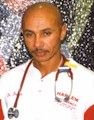 One
New York-based doctor who has heeded the call for health care
improvement in the Black community of Harlem is Dr. Dennis Brown.
As a physician�s assistant he saw a need to return to medical
school in order to better serve the community of his youth. Today,
the 49-year-old trauma specialist in the Harlem Hospital emergency
room is challenging the status quo, bucking a high-paying
physician�s job and dedicating his services and talents to his
community. One
New York-based doctor who has heeded the call for health care
improvement in the Black community of Harlem is Dr. Dennis Brown.
As a physician�s assistant he saw a need to return to medical
school in order to better serve the community of his youth. Today,
the 49-year-old trauma specialist in the Harlem Hospital emergency
room is challenging the status quo, bucking a high-paying
physician�s job and dedicating his services and talents to his
community.
Dr. Brown�s motivation and inspiration for
working in the impoverished community is quite simple. "It
was the idea of public service ... making a difference," he
said. "There are too few of us who understand the need to be
in the trenches. The need to be dealing with the very sick in our
community is a very special calling. Gone are the days of the big
bucks. People laugh at me when they see me jump into my beat-up
old jeep. They think I have a Mercedes parked in my driveway. For
90 percent of us working in Harlem Hospital, it is about improving
the health care of our people," he added.
Dr. Nivet, who says the need for doctors to
return to their community is of the utmost importance, applauds
the efforts of Dr. Brown. He also sees the need to organize
communities around the issue of health care. "The information
concerning the seriousness of our problem doesn�t flow to our
community," Dr. Nivet said. "People aren�t informed of
things like the Georgetown University Medical Center�s study
which showed that minority cardiac patients are less likely than
whites to receive appropriate treatment," he added. Nor is it
widely-known that the Kaiser Family Foundation released a report
which stated 12 percent of Blacks questioned, and 13 percent of
Latinos felt that they had been discriminated against by health
providers. Other studies have shown that Black and minority
patients feel that their quality of care is not equal to that of
whites.
"Good physicians need to understand how
social, cultural and economic factors influence the health of
their patients and the patterns in which they seek out health care
and respond to medical services," Dr. Nivet said, adding that
Blacks and Latinos must insist that affirmative action in medical
school recruitment continue.
Dr. Nivet�s point is supported by statistics
published in "The National Agenda for the Million Family
March" released in February. According to the agenda, 1992
saw Black males die of heart-related diseases at a 46 percent
higher rate than that of white males. For Black females the rate
was a staggering 69 percent higher than white females.
Acknowledging the problem and implementing
solutions are sometimes worlds apart. Doctors like Dr. Gerald
Thompson, senior associate Dean of the College of Physicians and
Surgeons, and Dr. Michael Harris, Ph.D., director of Minority
Affairs, both at Columbia University, are providing guidance and
mentoring for undergrads who may be considering a career in
medicine. The Minority Affairs Department recently held a one-day
conference to inform students about the benefits of working in
medical-related professions.
Factors such as poor or inadequate schooling
are the greatest barriers students face, according to Dr. Harris.
"We even have students telling us of teachers that try to
discourage them from not only medical school, but college
altogether. I think we need to become activists�be in the street�get
into people�s faces, talk about what must change in the
education system," offers Dr. Harris. Schools like Columbia
have been working with high school students for many years. New
programs have been extended into junior high, and plans are being
drawn to start working with elementary grades. The main areas of
concentration will be science and math, according to Dr. Harris.
Dr. Thompson, however, would rather talk of the
20-year legacy of the conference and Columbia University�s
continuing commitment to recruiting minority students into the
medical profession. "I know there is ongoing concern because
we are not appreciably increasing our numbers," said the
well-respected educator and doctor. "We will meet our
goals," he said confidently. "We want improvement in the
quality of teaching particularly in science at the high school
level."
The Association of Medical Colleges has
reported that it is only half-way to the goal of recruiting 3,000
doctors. "We need to regroup, start working with students at
the lower grades," said Dr. Nivet. "We must put pressure
on the school system and the politicians."
Dr. Muhammad concurs. "It begins with
understanding that we are a community that must be responsible for
one another. As parents we must take a harder look at our
children. We do not need another basketball player. We must demand
from parents that their children enter the medical professions. It
is no longer something that we ask�it is something that must be
demanded."
(Corey Muhammad contributed to this report.) |
