GOP adds Black symbols,
substance questions linger
|
by Askia Muhammad
White House Correspondent
PHILADELPHIA (FinalCall.com)�While the numbers of Black delegates
at the 2000 Republican National Convention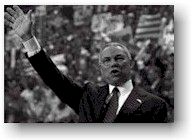 may not be substantial compared
to their representation in the general population�92 Black delegates and
alternates, amounting to 4.1 percent of the total, which is larger than
the 57, or 2.7 percent who attended in 1996�the participation of
prominent Blacks from both inside and outside the GOP did increase
dramatically at this convention. may not be substantial compared
to their representation in the general population�92 Black delegates and
alternates, amounting to 4.1 percent of the total, which is larger than
the 57, or 2.7 percent who attended in 1996�the participation of
prominent Blacks from both inside and outside the GOP did increase
dramatically at this convention.
Retired Gen. Colin Powell, led off the convention,
addressing the delegates on the July 30 opening night, during a program
that included a gospel choir and hip-hop music.
Gen. Powell spoke of America�s Promise, the same name
of a service organization he heads, in his remarks. Noting America has
seen economic good times, he also said racism persists and must be
confronted, and more needs to be done to help children trapped by crime,
drugs and poverty.
"There are two million men in jail and these are
men who are not paying taxes or supporting their families, and many of
them are the minority race. To deliver this promise we must begin with our
children. ... Either we are going to build children or build more jails.
Children are not the problem, the problem is us. We fail to give them the
necessities," he said.
He called for a recommitment to parenting and moral
values, foster parenting, quality health care and after school programs
for youth.
He also gave a ringing endorsement of Gov. Bush and
vice presidential candidate Dick Cheney.
"Gov. Bush will bring back the passion for the
inclusion of all minorities. Bush will help to bridge the racial divide.
At one time the Republican Party was the party of minorities and Bush
wants it to wear the mantle of the party of Lincoln," he said.
Gen. Powell also challenged Republicans who have fought
affirmative action, that "gave jobs to a few thousand Black
people," to challenge lobbyists who carve out tax privileges for
special interest groups.
Gen. Powell is rumored to be presidential nominee
George W. Bush�s first choice to be named secretary of state if he is
elected in November. In addition, Dr. Condoleeza Rice, who served as one
of several under-secretaries of state under the elder George Bush�President
Bush�has been representing the younger Mr. Bush as a foreign policy
spokesperson on Sunday television interview programs throughout this
campaign season, and was a prominent VIP at this convention.
Rep. J.C. Watts (R-Okla.), House Republican Caucus
chairman�the fourth highest position among GOP members of Congress�served
as deputy convention chairman, was moderator of the proceedings during the
second, prime-time evening session, and hosted a reception honoring Black
delegates and alternates.
BET Founder Robert Johnson addressed an all day Black
Republican Leadership Caucus hosted by the National Black Republican
Leadership Council (NBRLC), and songwriter Kenny Gamble was also slated to
speak to delegates on community development.
Even NAACP President Kweisi Mfume, who was denied his
request to speak to the assembly, was invited by the NBRLC to speak to a
private breakfast meeting along with several clergy members.
But all of the high profile participation of Blacks in this convention,
and the party�s professed commitment to "diversity" may in
fact be a ruse, intended to appeal to moderate white voters, and not
necessarily a sincere effort to attract more Blacks to the Republican
ranks, some say.
These "stylistic changes are trying to appeal to
moderate whites, to make the Republican Party appear to not be so
in-your-face-confrontational, and so ideologically �hard right,�"
Dr. Ronald Walters, a professor of political science at the University of
Maryland told The Final Call.
Republican strategists would be content to get 15 to 18
percent of the Black vote, said Dr. Walters, who pointed out that
President George Bush received "strong" (by modern electoral
standards) Black support of more than 15 percent in his re-election
attempt.
President Richard Nixon set the modern high water mark
of 20 percent of the Black vote in 1972. War hero (like Gen. Powell)
Dwight Eisenhower, enjoyed very strong Black support in his campaigns,
rivaling the traditional (Party of Abraham Lincoln) support Blacks had
given to Republicans up until Franklin Roosevelt�s chicken-in-every-pot
New Deal policies broke the Republican grip, when he campaigned against
conservative Herbert Hoover.
This year, the GOP is also fielding several Black
congressional candidates.
While most of the Black Republicans are running against
Black Democratic incumbents in what are usually considered to be
"safe" Democratic districts in Florida, and Georgia; one
Republican candidate�Joan B. Johnson�is challenging Rep. Rick Lazio
(D-N.Y.) for the 2nd District seat, while another Black Republican�Marvin
Scott�is challenging a Black Democrat�Rep. Julia Carson�in Indiana�s
10th Congressional District, which has a predominately white population.
Three of the four Black GOP congressional candidates�Jennifer
Carroll, Ms. Johnson, and Dylan Glenn�are given "good chances"
of winning by Rep. Watts and by officials at the National Republican
Congressional Campaign Committee.
Black Democrat Sanford Bishop (D-Ga.), who represents a
rural district that has been recently reapportioned to include many more
whites, may potentially be the most vulnerable, according to sources
familiar with the Congressional Black Caucus.
Rep. Bishop was the only CBC member targeted for
removal from office by name when Black farmers rallied on Capitol Hill in
support of Reps. Watts and Jay Dickey (R-Ark.), who sponsored a
non-binding "sense of the Congress resolution" in support of
quick payments by the Department of Agriculture to tens of thousands of
Blacks who lost their family farms. The measure was opposed by the entire
CBC.
While a source close to Rep. Corrinne Brown (D-Fla.)
suggests that Ms. Brown will be easily re-elected, Rep. Brown herself
expressed a healthy respect for her opponent. "They made (Jennifer
Carroll) retire from the Navy so she could run against me," Rep.
Brown told The Final Call, suggesting that her campaign needs money
to better compete with her well-financed opponent.
Born in Trinidad, West Indies, and reared in the U.S.
since the age of eight, Lt. Cdr. Carroll served 20 years in various posts
associated with naval aviation and has lived in the Jacksonville, Fla.
area since 1986.
(Michael Z. Muhammad contributed to this report.) |


