 UNITED NATIONS (IPS)�Israeli curfews and travel restrictions
imposed on Palestinians following a wave of suicide bombings earlier
this year have left the civilian population "scrambling to survive,"
says the UN envoy to the region.
UNITED NATIONS (IPS)�Israeli curfews and travel restrictions
imposed on Palestinians following a wave of suicide bombings earlier
this year have left the civilian population "scrambling to survive,"
says the UN envoy to the region.
"Throughout the West Bank and Gaza Strip, Palestinians have run out
of money and are unable to work to earn it," Terje Roed-Larsen said
recently. "They increasingly must rely on handouts, selling personal
items, credit�anything simply to survive."
Seventy percent of all Palestinians are living on less than two
dollars a day, according to a new UN report due out at Final Call
press time. More than one-half lack jobs, with income losses amounting
to a staggering $7.6 million a day.
The Palestinian economy has been deprived of almost $3.3 billion
since October 2000, a month after the current Intifada erupted, partly
because Israel has been withholding tax revenues, Mr. Roed-Larsen said.
"I am deeply disturbed by the figures. But I am not surprised, given the
iron grip that Israel has applied to the West Bank."
"On some days, more than a million people have been confined to their
homes. I must admit I struggled to find a recent precedent for this�and
cannot," he said.
Since October 2000, most Palestinians have been barred from working
in Israel, and travel restrictions within the West Bank and Gaza Strip
have made it increasingly difficult for them to get to their jobs. The
report notes that on most days this summer, between 500,000 and 900,000
people were confined to their homes.
"If anyone doubts what I am describing, pay a visit to Nablus, which
has been under 24-hour curfew almost daily throughout this hot summer,"
the envoy said.
"As one prominent Palestinian said to me this week: �Life under
occupation is like an agonizing tooth�dying is like taking it out.� I am
saying this because it illustrates the despair and agony that can lead
to extremism."
Roed-Larsen condemned the terror attacks on Israeli civilians that
prompted the lockdowns, but said the curfews and roadblocks were a form
of collective punishment that have "devastated Palestinian society."
But Lt. Col. Yarden Vatikay, an Israeli Defense Ministry spokesman,
said the measures were legitimate. "Terje Larsen is not the defense
minister of the state of Israel," he said. "He should leave it to us to
say what�s necessary to protect our people."
A report released in August by the U.S. Agency for International
Development (USAID) and the charity Care International also warned of a
humanitarian disaster in the West Bank and Gaza Strip, as the Israeli
government announced even tighter controls on Palestinians following the
deaths of 13 Israelis in militant attacks in 24 hours.
One-fifth of Palestinian children under five are suffering from
malnutrition, largely due to Israeli blockades, says the USAID report.
In addition to income losses, the World Bank says that Israeli damage
to Palestinian infrastructure, funded mostly by the European Union, is
estimated at between $600 million and $800 million.
"It�s difficult to be optimistic about the (curfew) situation
improving," said Khalil Jahshan, executive vice president of the
Washington-based Arab Anti-Discrimination Committee.
"We�ve had several assurances from the Bush administration. They say
the president is very concerned about this. The issues have been raised
again and again with Israel. But nothing has happened, despite
assurances from Israeli officials, especially Foreign Minister Shimon
Peres."
"The Israelis are dragging their feet," Mr. Jahshan added. "The
administration has given them moral and political support, so there
doesn�t seem to be any incentive for Israel to move forward. We expect
the situation to continue to deteriorate."
Phyllis Bennis, a fellow at the Washington-based Institute for Policy
Studies, agreed. "What this (report) may do is spark a certain kind of
charity, but it�s not going to solve the problem," she said. "The
problem is occupation."
"The Bush administration has embraced everything that Sharon is
prepared to do. If they really wanted to accomplish something, they�d
have to stop the inexhaustible flow of military aid," she added.
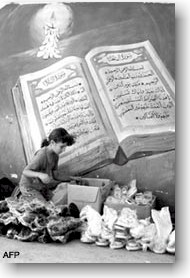
Caption:
A young Palestinian girl sells shoes September 3 in the streets of Askar
refugee camp, near the West Bank town of Nablus. The curfews imposed by
Israel on reoccupied Palestinian towns, restrictions on the movements of
goods and people, and the unemployment caused by the barring of workers
from entering Israel have left most of the population of the West Bank
and Gaza Strip in poverty, according to experts and officials. -Photo:
AFP



