by Saeed Shabazz
Staff Writer
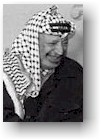 NEW YORK (FinalCall.com)�Yasser
Arafat isn�t stepping down as leader of the Palestinian Authority but
hasn�t decided whether he will run again for Palestinian president.
According to July 12 reports from his Ramallah compound, the Palestinian
president told the media, only senior Palestinian officials and his
people can decide his fate. He has also expressed a willingness to keep
talking to a U.S. administration that wants him gone.
NEW YORK (FinalCall.com)�Yasser
Arafat isn�t stepping down as leader of the Palestinian Authority but
hasn�t decided whether he will run again for Palestinian president.
According to July 12 reports from his Ramallah compound, the Palestinian
president told the media, only senior Palestinian officials and his
people can decide his fate. He has also expressed a willingness to keep
talking to a U.S. administration that wants him gone.
So as U.S. President George Bush, Secretary of State Colin Powell,
National Security Advisor Condoleezza Rice and others call for his
resignation, Mr. Arafat remains a powerful symbol. Western detractors
may lob criticism and old adversary Ariel Sharon, the Israeli prime
minister, may call him "irrelevant," but Yasser Arafat is not a man
easily dismissed.
Biographers say Mr. Arafat is strongest when under siege. He is a
guerilla fighter and surviving tough times are engrained in him, they
say.
"Palestinians believe strongly that they still need Mr. Arafat. He is
the elected leader and the symbol of national aspirations," said Khalil
Shikaki, a Palestinian and a visiting fellow at the Brookings
Institution�s Saban Center in Washington, D.C. According to Mr. Shikaki,
Mr. Arafat is legendary because he has done more than anyone else to put
the Palestinian cause on the world agenda.
Born to Palestinian parents in Cairo, Egypt on August 24, 1929, he is
one of seven children, his father was a successful merchant. His mother,
who was said to be devoted to her religion, died when he was just four.
His birth name was Mohammed. He was nicknamed "Yasser," which means
"easy", by playmates.
After his mother�s death he went to live with a married uncle in
Jerusalem. Then as a teenager in the 1940s, Mr. Arafat became involved
in Palestinian causes. The effort to establish the state of Israel on
Palestinian land was underway. At age 17, he smuggled weapons for
fighters from Cairo. He participated in some of the battles of the 1948
war with Israel, preaching that Palestinians should do their own
fighting to protect their country.
After the war�s end, he entered the King Fahd University, now Cairo
University, earning a degree in civil engineering. There he met future
Palestinian Liberation Organization (PLO) compatriots Salah Khalaf (Abu
Iyad), Salim Zannum (Abu Adeeb) and others. In 1952, Mr. Arafat was
elected president of the Union of Palestinian Students. He led
demonstrations for Palestinian liberation and edited a student
newspaper. He also managed to convince Egyptian authorities to allow him
to establish a military training camp in preparation for further
struggle inside Palestine. But he also ran afoul of Egyptian
authorities, who jailed him for his perceived collaboration with the
outlawed Muslim organization.
According to biographer, Alan Hart, Mr. Arafat�s first major act as a
guerilla was sabotaging a huge Israeli water storage plant near the town
of Faluja. This act, according to Mr. Hart provoked the February 1955
Israeli attack on Gaza, bringing Egypt and the Soviet Union together. It
also brought President Nasser, of Egypt, and Mr. Arafat closer. Offered
a post in the Egyptian Army, Mr. Arafat turned it down. He had other
plans. In 1957, he left Cairo for Kuwait, where he teamed up with Khalil
Wazir (Abu Jihad) and Khaled al-Hasan to form FATAH (the Movement for
the National Liberation of Palestine). He founded the Palestinian
Liberation Organization in 1964, but the Arab world ignored the group.
"He began to think of himself as another Nelson Mandela, Ho Chi Minh,
Fidel Castro, all rolled up into one �Third World� revolutionary
leader," Professor Naseer Aruri told The Final Call. Professor Aruri is
a retired political science teacher at the University of Massachusetts
and author of "The Obstruction of Peace: The U.S., Israel and The
Palestinians."
In the 1967 "Six Day War," Israel launched a preemptive strike
against Arab troops on its borders, seizing Sinai from Egypt, the Golan
Heights from Syria and the West Bank and the Old City of Jerusalem from
Jordan. After the defeat, the losers approached Mr. Arafat and the PLO
for help against Israel. "He had gained a far ranging reputation in the
Arab world as an astute guerilla fighter," Prof. Aruri noted.
It was in a 1968 PLO clash with Israel, known as the Battle of
Karameh, that Mr. Arafat gained more recognition as a warrior. In
September 1970 battles against Syria and the Israeli siege against the
PLO in Beirut, Lebanon. In 1982, Mr. Arafat was again recognized as a
man of great fortitude. He refused to wilt under pressure.
"Yasser Arafat was very muscular as a young man. He was always
smiling. The legend of his courage is widespread," remembers journalist
Akram Zadeh, 69, who said he met Mr. Arafat in Iran, when they were
young. Mr. Zadeh recalled a story of an airplane crash in North Africa,
involving Mr. Arafat and his comrades. According to Mr. Zadeh, everyone
except Mr. Arafat perished.
During his tenure as PLO chairman, the United Nations reaffirmed the
rights of the Palestinians to statehood and the right of Palestinian
refugees to return home. He was also able to get the UN to affirm in
writing that the Palestinian people had a "right to struggle by all
means necessary," including "military resistance" to secure these
rights. The PLO was the preeminent Palestinian resistance movement and
Mr. Arafat was its unquestioned leader. In the United States and Israel,
however, the PLO was branded a terrorist group. Over time and after much
bloodshed, the PLO offered some concessions. One major step was
recognizing Israel�s right to exist.
In 1988, Mr. Arafat made concession to the United Nations, saying the
PLO would recognize Israel as a sovereign state. He negotiated the Oslo
Accords in 1993, which gave the Palestinians self rule. For that effort,
he and Israeli leaders Shimon Peres and Yitzhak Rabin received the 1994
Nobel Peace Prize.
"I will carry this Nobel Peace Prize to our children, who have a
promise of freedom, security in a homeland not threatened by an invader
from outside, or an exploiter from inside," Mr. Arafat said December 10,
1994
By 1996, Mr. Arafat was pushing for an agreement on self-rule for all
Palestinian cities and villages in the West Bank. He was then elected
president of Palestinian-controlled territory.
In 1999, French researcher Jean-Francois Legrain wrote that only Mr.
Arafat could assure a legitimate transition toward co-existence with
Israel. If he disappeared before the transition is settled�a bloody
conflict would ensue, he wrote. "A transition worked out after Arafat is
gone will be illegitimate and weak," Mr. Legrain added. That same year,
Mr. Arafat and the Israeli Prime Minister Ehud Barak signed an agreement
to finalize their borders and to determine the status of Jerusalem by
2000.
So despite Israeli and Bush administration campaigns to oust Yasser
Arafat, Palestinians remain unlikely to sign on and Mr. Arafat unwilling
to bow out.
Dr. Nasser Al-Kidwa, Permanent Palestinian Observer to the UN
explained why: "His mission is to lead the Palestinian people until the
establishment of an independent state. We are still in the phase of
national liberation, and I think he symbolizes the ambitions of the
Palestinian people during this stage. For him the office of president of
the Palestinian Authority is a mission rather than a post."



