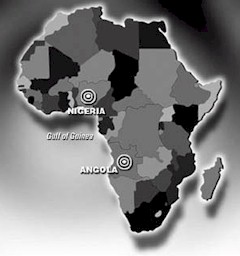
 WASHINGTON (IPS)--The State Department�s top official to Africa
recently visited Angola and Nigeria, spotlighting Washington�s growing
interest in and reliance on oil resources in the Gulf of Guinea, along
the continent�s West Coast.
WASHINGTON (IPS)--The State Department�s top official to Africa
recently visited Angola and Nigeria, spotlighting Washington�s growing
interest in and reliance on oil resources in the Gulf of Guinea, along
the continent�s West Coast.
Ensuring greater access to West African oil is high on the agenda of
Assistant Secretary of State Walter Kansteiner�s trip. Angola and
Nigeria are already the 8th and 5th biggest sources of foreign oil for
the United States.
Earlier this year, Mr. Kansteiner, speaking before a meeting of the
Institute for Advanced Strategic and Political Studies (IASPS) here,
called African oil a "national strategic interest" of the United States.
But IASPS, whose founder-director Robert Loewenberg has strong ties
to the right wing of Israel�s coalition-leading Likud Party, wants
Washington to go much further.
"Congress and the (Bush) administration should declare the Gulf of
Guinea an area of �vital interest� to the U.S.," according to a report
released in June by the institute, which is based in Jerusalem but has a
Washington office.
Some IASPS insiders also have links to the oil industry, Congress and
to right-wing elements in the Pentagon.
The report, which included the views of U.S. oil companies with
investments in West Africa, goes so far as to urge the establishment of
a U.S. military sub-command for the region, with basing rights and a
home port on the Gulf of Guinea islands of Sao Tome and Principe.
While the idea has not received much public attention, IASPS and its
founder-director, Robert Loewenberg, enjoy good access to senior
Pentagon officials, who would like to see the Arab-dominated
Organization of Petroleum Exporting Countries (OPEC) break up and are
actively interested in the sub-command suggestion.
Of the West African oil producers, only Nigeria is an OPEC member.
The Bush administration, which has actively courted the government of
President Olusegun Obasanjo, would like to see the nation leave the
group. Unhappiness within Nigeria over low OPEC export quotas has
fuelled recent speculation that the country may pull out even before the
end of the year.
While officials in former president Bill Clinton�s administration
shared Israeli interests in reducing U.S. dependence on Mideast oil,
last September�s terrorist attacks on New York and the Pentagon and the
unprecedented strains on U.S.-Saudi ties that followed brought new
urgency to that quest.
That urgency has been compounded by political instability in
Venezuela and Colombia, two important sources of U.S. oil; escalation in
the Palestinian-Israeli conflict; and Bush�s commitment to oust Iraqi
President Saddam Hussein by any means necessary.
"The ongoing tensions in the Middle East provide the most compelling
evidence yet of our nation�s need to diversify its sources of
petroleum," noted Rep. William Jefferson, a Democrat, at a hearing in
June of the House International Relations Committee. "In the long term,
African oil provides energy security for our nation."
Oil from the Gulf of Guinea is now the source of about 15 percent of
the 12 million barrels of oil imported by the United States each day. Of
that amount, Nigeria provides close to one million barrels a day. Only
Canada, Saudi Arabia, Venezuela, and Mexico are bigger sources.
Angola supplies about 333,000 barrels a day, according to government
statistics for 2001, while Equatorial Guinea, thanks to new, deep-water
drilling technology that is making the entire region more attractive to
U.S. oil companies, has increased production from nothing just a few
years ago to more than 200,000 barrels a day, much of that bound for the
United States.
Not everyone thinks more oil from Africa would be a positive move.
"It�s like these companies can own a platform, extract the oil, and
then just send a check to the government," said Michael Chege, director
of the Center for African Studies at the University of Florida. He fears
that such arrangements will evolve into an "alliance between the
�oilagarchy� and dictatorships" backed up by U.S. military power.
Still, West Africa�s share of the U.S. import oil market is expected
to grow to 25 percent as early as 2015, as new technology makes it
possible for companies to tap energy resources that were out of reach
until now.
In addition to Nigeria, Angola, and Equatorial Guinea, Gabon,
Congo-Brazzaville and Cameroon are already oil exporters, while Chad
will come on line after the construction of a major pipeline by
ExxonMobil. Oil companies are also actively exploring off the coasts of
Namibia, Cote d�Ivoire, Mauritania, and Moroccan-occupied Western
Sahara.
"Last year, there were eight billion barrel finds of oil in the
world: seven of those were off the coast of West Africa," says Rep.
Jefferson.
"Oil production (in Angola and Nigeria alone) is expected to double
or triple in the next 5 to 10 years," according to an unclassified study
by the Defense Intelligence Agency (DIA).
"West Africa oil is of high quality, is easily accessed off-shore,
and is well positioned to supply the North American market," adds the
study.
It is also isolated from potential social and economic problems,
notes Robert Murphy, an economic specialist with the State Department�s
Office of African Analysis. "Much of Africa�s oil is offshore, thereby
insulated from domestic and political or social turmoil," he says.



