The Final Call |
World News
In crisis, the rich get richer
By A.D. McKenzie | Last updated: Dec 20, 2011 - 12:43:08 PMWhat's your opinion on this article?
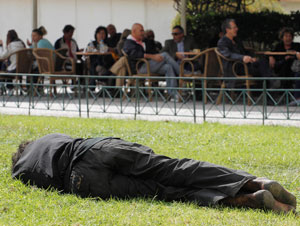
A homless man lies on a lawn in Athens' central square as people eat and drink at a cafeteria in Greece, heading into its fourth year of
recession in 2012, has seen a sharp rise in urban poverty and homelessness since the country's debt crisis began, according to welfare
groups. Photo: AP/Wide World photos
|
These are just some of the sights that have confronted Danielle Nierenberg as she traveled through 30 countries to supervise the Worldwatch Institute’s report titled “State of the World 2011: Innovations that Nourish the Planet.”
“You can see the stark differences within a single country very easily, and you see it every day,” she told IPS. “In Africa it doesn’t look like the recession has affected the very wealthy. It has affected poor people the most.”
Ms. Nierenberg was in Paris in early December to launch “Comment Nourir 7 Milliards d’Hommes” (How to Feed 7 Billion People), the French edition of the Washington-based think tank’s report.
While that publication focuses mostly on agriculture in Africa, its launch coincided with the presentation of a new report Dec. 5 by the Organization for Economic Co-operation and Development that spells out the rising gap between rich and poor in the OECD’s 34 member states.
Both surveys are a call to governments to take action to alleviate poverty and inequality, and to invest more in people who need assistance, whether in developed or developing countries. The OECD report puts in figures and graphs what is a reality for many people working on the ground in various regions.
Called “Divided We Stand: Why Inequality Keeps Rising,” the OECD survey finds that the “average income of the richest 10 percent is now about nine times that of the poorest 10 percent” across the organization.
Even in “traditionally egalitarian countries,” such as Denmark, Sweden and Germany, the income gap has risen from five to one in the 1980s to six to one today. The gap is 10 to one in the United Kingdom, Italy, Japan and Korea, and higher (at 14 to one) in the United States, Israel and Turkey, according to the report.
New data for the United States show that the “share of after-tax household income for the top 1 percent more than doubled” from 1979 to 2007, while the share of the “bottom” 20 percent of the population fell from seven percent to five percent.
“This is one of our most important assessments,” said the OECD’s Secretary-General Angel Gurria as he launched the report at the organization’s headquarters here. “We say ‘divided we stand’ because we have grown unequally.”
Mr. Gurria said that “only a few countries have managed to buck the trend.” Income inequality has recently fallen in Chile and Mexico, but in these two countries the incomes of the richest are still more than 25 times those of the poorest, he said.
Outside of the OECD area, income inequality is much higher in some major emerging economies. For instance, although the Brazilian government has taken measures to redistribute wealth, with inequality falling over the past decade, the country’s income gap is still 50 to one, or five times the OECD average, the report says.
“There are countries that are non-OECD members, where a sustained period of strong economic growth has allowed some emerging economies to lift millions of people out of absolute poverty,” Mr. Gurria told journalists.
“The benefits of strong economic growth, however, have not been evenly distributed. High levels of income inequality have risen further. Among the dynamic emerging economies, only Brazil managed to strongly reduce inequality.”
The OECD says that the main reasons for the rising income gaps have been greater inequality in wages and salaries, the reduction in benefits, and cuts in top tax rates for high-earners.
Both Gurria and Nierenberg said separately that the global economic crisis has increased the urgency for governments to take action on these issues.
“The social contract is starting to unravel in many countries,” Mr. Gurria said. Uncertainty and fears of social decline and exclusion have reached the middle class in many societies. People feel that they are bearing the brunt of a crisis for which they have no responsibility while those on high incomes appear to have been spared.”
He said that the OECD’s recommendations included increasing marginal tax rates on the rich.
For her part, Ms. Nierenberg would also like to see transparency, especially in the way that rich and emerging economies are buying farm properties (“land grabbing”) in Africa, increasing poverty and inequality in some countries.
“When food prices have risen so high and people’s incomes haven’t risen along, you see the effects of that: kids with bloated bellies, all the typical signs of malnutrition and impending famine in ways that you wouldn’t have seen maybe five or six years ago,” she told IPS.

News Search
Loading
Follow The FinalCall.com Networks



Join The FinalCall.com e-List


 Click Here Stay Connected!


For Email Marketing you can trust
Farrakhan Articles
- Condemning Belgium’s King Leopold II and enslavement, murder of 10 million Congolese
- Police brutality in the U.S., its roots and some views from the Motherland
- The Motherland’s powerful influence on Islam
- Seattle, Sudan and unlikely similarities in autonomous zones, calls to end repression
- Motherland stands with Black America’s fight against rampant police violence
- Pandemic impacts Africa’s informal cross border trade
- Ethiopian rabbis win court victory in Israel, but struggle continues for Africans in the Zionist State
- The history of Cuba’s unprecedented humanitarian work in Africa
- Pandemic shaping economic, social climate of East and Southern Africa
- African women farm majority of Africa’s food but own less than majority of land
INSIDE STORIES AND REVIEWS
-

-

About Harriett ... and the Negro Hollywood Road Show
By Rabiah Muhammad, Guest Columnist » Full Story -

Skepticism greets Jay-Z, NFL talk of inspiring change
By Bryan 18X Crawford and Richard B. Muhammad The Final Call Newspaper @TheFinalCall » Full Story -

The painful problem of Black girls and suicide
By Charlene Muhammad -National Correspondent- » Full Story -

-

-

-

Exploitation of Innocence - Report: Perceptions, policies hurting Black girls
By Charlene Muhammad -National Correspondent- » Full Story -

Big Ballin: Big ideas fuel a father’s Big Baller Brand and brash business sense
By Bryan Crawford -Contributing Writer- » Full Story -
