The Final Call |
World News
Rural farmers key to African development
By Miriam Mannak | Last updated: Jul 2, 2009 - 10:12:25 PMWhat's your opinion on this article?
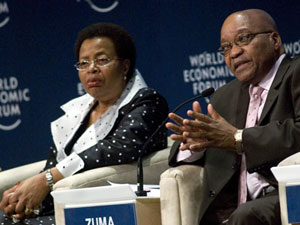
Former First Lady of Mozambique, and Human Rights activist, Graca Machel (L), listens while South African President Jacob Zuma makes a point, in the final plenary session called, ‘Africa's Roadmap, From Crises to opportunity' during the final day of the World Economic Forum Meeting on Africa, on June 12, in Cape Town.
‘The average African small holding farmer swims alone. She has no insurance against erratic weather patterns, gets no subsidies and has no access to credit. I say ‘she' because the majority of small-scale farmers in Africa are women.’ —Kofi Annan, former secretary general to the UN |
This is the position that emerged from the World Economic Forum on Africa, which concluded on June 12.
“We have approximately 80-million small-scale farmers in Africa who produce very little—not because they do not want to be more productive, but because they are not able to,” argued Florence Wambugu, founder of Africa Harvest Biotech Foundation.
Her organization, based in Kenya, aims to support farmers in east Africa by, among other things, promoting the use of modern technologies such as biotechnology.
“Raising these farmers' productivity is possible and it is key to Africa's food security and overall economic growth,” she added.
Numerous obstacles face small-scale farmers in Africa, she told IPS. These vary from a lack of infrastructure to no access to credit and new technology and little or no support from government and financial institutions.
Kofi Annan, chairperson of the Board of the Alliance for a Green Revolution in Africa (AGRA), acknowledged this.
“The average African small holding farmer swims alone,” the former secretary general to the United Nations stated. “She has no insurance against erratic weather patterns, gets no subsidies and has no access to credit. I say ‘she' because the majority of small-scale farmers in Africa are women.”
AGRA is a non-governmental organization that aims to alleviate poverty among Africa's small-scale farming communities.
Nick Moon, co-founder of Kickstart International—a non-profit organization that develops low-cost technologies for cash-poor farmers—stressed that poor irrigation infrastructure plays an important role in the farmers' hardship and the food insecurity in the region.
“Only four to five percent of agricultural land in Africa is irrigated. The rest is rain fed,” he said. Few small-holding farmers in sub-Saharan Africa “live in close proximity to a water source, whether it is ground or surface water. This is a problem, especially because of climate change.
“Therefore, when addressing the needs of small scale farming, more attention should go to water and irrigation infrastructure.”
Access to markets is crucial when it comes to empowering poor farming African communities, Ms. Wambugu added. “Many struggle with marketing their produce,” she said.
“International trade barriers to protect farmers in rich countries definitely play a role but the existing regional tariffs are also obstacles,” she argued. “Creating a regional market for African products will stimulate their production as they are enabled to sell their surplus and we improve the continent's food security and thus the overall economy.”
Statistics by African Economic Outlook, which provides economic information and analysis on Africa's economies, indicate that intra-African trade in 2008 amounted to $424.14 billion of which 17.1 percent was accounted for by agriculture.
During the WEF on Africa meeting, it was also argued that African governments—apart from opening their markets to agricultural products from elsewhere on the continent—should keep their promise to spend 10 percent of their budgets on agriculture.
In 2003, with the Maputo Declaration, African leaders committed themselves to national budget allocations of 10 percent to agriculture by 2008 as part of their attempts to meet the first Millennium Development Goal—fighting hunger and poverty.
Six countries have met that goal so far, with the average spending on agriculture in the African Union being five to six percent.
One of the countries that is meeting this obligation is Rwanda. “Agriculture is an important driver of economic development, especially in Africa where so many people rely on farming,” Rwandan president Paul Kagame said.
“If you enable farmers to increase their productivity, you increase your gross national product (GDP) and you lift people out of poverty. Africa can become the world's breadbasket, but you need to work on it. Investing in agriculture is easier than to have millions of people starving,” he added.
According to Ms. Wambugu it is important for African governments to focus more on rural development. “It is there where the majority of people live. By not making rural areas more attractive, people will continue to flock to the cities hoping for a better life. This is not beneficial to the continent's food security.”
Figures by the United Nations Centre for Human Settlements show that Africa's urbanization rate of 3.5 percent per year is the highest in the world and is predominantly triggered by rural poverty. It is estimated that by the year 2030, over half of the continent's population will live in cities and rural settlements.
South Africa is one of the countries that has pledged to put more energy in rural development.
In his first state of the nation address in June 2009, newly-elected president Jacob Zuma said that by “working together with our people in the rural areas, we will ensure a comprehensive rural development strategy linked to land and agrarian reform and food security.
“People in the rural areas have a right to be helped with farming so that they can grow vegetables and other things and raise livestock so that they can feed themselves.”
Ms.Wambugu applauds these promises. “This change of mindset is needed across the continent. Rural-based development is the way forward for Africa.”

News Search
Loading
Follow The FinalCall.com Networks



Join The FinalCall.com e-List


 Click Here Stay Connected!


For Email Marketing you can trust
Farrakhan Articles
- Condemning Belgium’s King Leopold II and enslavement, murder of 10 million Congolese
- Police brutality in the U.S., its roots and some views from the Motherland
- The Motherland’s powerful influence on Islam
- Seattle, Sudan and unlikely similarities in autonomous zones, calls to end repression
- Motherland stands with Black America’s fight against rampant police violence
- Pandemic impacts Africa’s informal cross border trade
- Ethiopian rabbis win court victory in Israel, but struggle continues for Africans in the Zionist State
- The history of Cuba’s unprecedented humanitarian work in Africa
- Pandemic shaping economic, social climate of East and Southern Africa
- African women farm majority of Africa’s food but own less than majority of land
INSIDE STORIES AND REVIEWS
-

-

About Harriett ... and the Negro Hollywood Road Show
By Rabiah Muhammad, Guest Columnist » Full Story -

Skepticism greets Jay-Z, NFL talk of inspiring change
By Bryan 18X Crawford and Richard B. Muhammad The Final Call Newspaper @TheFinalCall » Full Story -

The painful problem of Black girls and suicide
By Charlene Muhammad -National Correspondent- » Full Story -

-

-

-

Exploitation of Innocence - Report: Perceptions, policies hurting Black girls
By Charlene Muhammad -National Correspondent- » Full Story -

Big Ballin: Big ideas fuel a father’s Big Baller Brand and brash business sense
By Bryan Crawford -Contributing Writer- » Full Story -
