The Final Call |
National News
Federal gov't complicit in pushing low wages for workers, charge advocates and a recent report
By Askia Muhammad -Senior Editor- | Last updated: May 24, 2013 - 10:51:16 AMWhat's your opinion on this article?
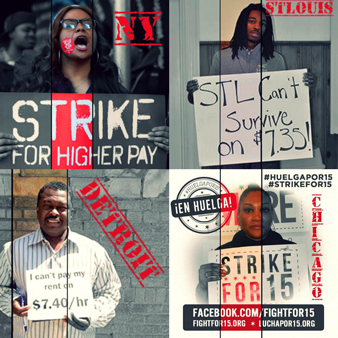
Low-wage workers are uniting all over the country to demand decent pay—a so-called “living wage.” Photo/graphic: FightFor15/Facebook
|
As the Mother’s Day holiday approached, fast food workers in Detroit walked off the job joining a nationwide movement. Their “Fight for 15” campaign is demanding a near doubling of worker wages to $15 per hour and the freedom to unionize without the fear of retaliation. According to published reports 60 Detroit restaurants were affected. In addition, workers in St. Louis from about 30 restaurants, including McDonalds, Wendy’s and Dominos, walked out in a similar protest.
Meanwhile, here in Washington, hundreds of workers gathered near Capitol Hill to complain that the federal government actually employs more low-wage workers than McDonald’s and Wal-Mart combined, this according to a new study by the consulting firm Demos.
“By distancing itself from these workers, often through outsourcing, the federal government is betraying its own principles to provide decent wages embodied in laws, such as the Service Contract Act,” Congresswoman Eleanor Holmes Norton (D-D.C.) told the assembly, organized by the House Progressive Caucus.
“The federal government then allows exploitative employers often to pass on to federal taxpayers the cost for health insurance and other benefits that private employers who offer decent wages generally shoulder.
Tessie Harrell demonstrates with other union members and fast-food, retail workers in Milwaukee as they staged a protest on Wisconsin Avenue in front of the Grand Avenue Mall May 15. The protest in Milwaukee is the latest in a string of fast-food job actions across the country. In recent weeks, protests have occurred in St. Louis, Chicago, Detroit and New York City. Photo: AP/Wide world photo
|
Tony German is a truck driver from South Carolina who works for a contractor who has raked in more than $6 billion in federal government contracts over the past decade, yet his wages have remained stagnant.
“Drivers like myself see very little of this $6 billion dollars,” Mr. German said. “In fact, we feel like we’re sharecroppers on wheels. Last year I made $36,000. My pay haven’t increased in 13 years. The price of tires, oil, insurance, and fuel, that we pay for is skyrocketing.
“I have no retirement, no dental, or no health plan. My great-grandfather was a slave. Back then you could see the chains. Now the chains are invisible for both Black and White drivers. I am here to ask the President: Mr. President, please. Help us. We need help. Release us from this poverty. Thank you.”
He was not alone. Others spoke in both English and Spanish. “My name is Roxanne Mimms and I work for a food service contractor at the National Zoo. I work full-time but make barely minimum wage. I’m here because workers can’t live off what contractors pay us. I’m here because I don’t want my two children to grow up on public assistance. I’m here because I have dreams. My American Dream is a good job with fair wages to provide for my children, being able to pay my bills on time and save for the future. I’m here because I want to help all the workers at the National Zoo whose dreams are on hold,” she said.
Workers such as Mr. German and Ms. Mimms would command a decent wage if they worked for the federal government itself, according to Del. Norton. “This press conference is taking place at Union Station for a reason,” she said “and it is not because of its iconic beauty or its historic architecture. Union Station is emblematic of the many federal institutions through which the federal government enables low wages. Union Station is federal property, which, like the National Zoo, the Ronald Reagan Building and others, leases or contracts with commercial vendors. The federal government then washes its hands, leaving these workers to be exploited with insufficient pay to live on.”
In their report “Underwriting Bad Jobs: How Our Tax Dollars Are Funding Low-Wage Work and Fueling Inequality,” Amy Traub and Robert Hiltonsmith of Demos Consulting found that “nearly two million private sector workers employed by government contractors, paid by federal health care spending, supported by Small Business Administration loans, working on federal construction grants, and maintaining buildings leased by the federal government earn $12 an hour or less (in some cases, much less). We the taxpayers are fueling a vast low-wage economy along the same lines as notorious low-road employers like Wal-Mart and McDonalds, whose workers are also standing up for better treatment.
“At the same time, not everyone working on behalf of America earns low wages. Many senior executives at companies with federal contracts are doing very well for themselves. And we as taxpayers provide generous reimbursements to them. Today, federal contractors can be reimbursed for as much as $763,029 in compensation for any given employee. The president of the United States earns about half that much,” Ms. Traub said.
“In one of the categories we studied, over $446 billion went to private businesses for federal contracting work in 2012 employing 2.2 million workers, 560,000 of which were paid less than $12 an hour,” said Mr. Hiltonsmith, the report co-author. “Similarly, a staggering $552 billion supported 3.7 million jobs at private healthcare facilities. Despite the important role these workers play in caring for the country’s ill, elderly, disabled and veteran populations, almost one-third of these tax dollar-supported healthcare positions were low-wage, paying too little to support a family.”

News Search
Loading
Follow The FinalCall.com Networks



Join The FinalCall.com e-List


 Click Here Stay Connected!


For Email Marketing you can trust
Farrakhan Articles
- Unmasking Mr. Dershowitz
- Activists charge environmental poisoning and ‘silent homicide’ in San Francisco
- President spews more incendiary rhetoric as election draws closer
- Covid-19 and the divine chastisement of Florida
- The National Guard was deployed in Atlanta, what does this mean as shootings, violence plague other American cities?
- Our babies are dying, where are our friends?
- Hurling truth at Falsehood Nation of Islam responds to lies of Atty. Alan Dershowitz
- The impact of a universal message
- Police traffic stops in nation’s capital disproportionately target Blacks
- A Call to Action’ to address Covid-19 in Black Chicago
INSIDE STORIES AND REVIEWS
-

-

About Harriett ... and the Negro Hollywood Road Show
By Rabiah Muhammad, Guest Columnist » Full Story -

Skepticism greets Jay-Z, NFL talk of inspiring change
By Bryan 18X Crawford and Richard B. Muhammad The Final Call Newspaper @TheFinalCall » Full Story -

The painful problem of Black girls and suicide
By Charlene Muhammad -National Correspondent- » Full Story -

-

-

-

Exploitation of Innocence - Report: Perceptions, policies hurting Black girls
By Charlene Muhammad -National Correspondent- » Full Story -

Big Ballin: Big ideas fuel a father’s Big Baller Brand and brash business sense
By Bryan Crawford -Contributing Writer- » Full Story -
