The Final Call |
National News
Oklahoma, other tornado-hit states brace for more
By AP | Last updated: May 21, 2013 - 1:17:56 PMWhat's your opinion on this article?
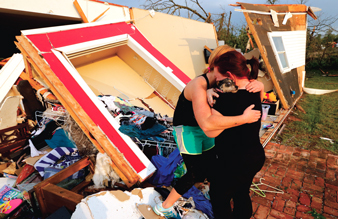
Friends and neighbors help out a resident in Lyon County just south of Emporia, Kansas, May 19 after an apparent tornado touched down.
|
The May 19 tornado that tore part of the roof from Ms. Carter’s frame house—one of few such homes in the Steelman Estates Mobile Home Park near Shawnee—laid waste to many of her neighbors’ places, and killed two people and injured several others.
The tornado was one of several that touched down in the nation’s midsection, concentrating damage in central Oklahoma and Wichita, Kansas. Two people were killed in or near the mobile home park, which is outside of Shawnee, a community about 35 miles southeast of Oklahoma City.
At least 39 people throughout Oklahoma were injured, according to the state’s emergency management director.
The National Weather Service was forecasting more of the same for the region—including Oklahoma City and Tulsa, warning of the possibility of tornadoes and baseball-sized hail. Residents of Arkansas, Kansas and Missouri were also warned to watch for bad weather.
Gov. Mary Fallin began touring the hardest-hit areas early May 20, including Carney, in Lincoln County, and a mobile home park near Shawnee, 35 miles southeast of Oklahoma City, that suffered a direct hit and was where the two confirmed deaths happened. Forecasters had been warning of bad weather since May 15 and on May 19 said conditions had ripened for powerful tornadoes.
Tornadoes were reported in Iowa, Kansas and Oklahoma as part of a storm system that stretched from Texas to Minnesota.
At the nearby intersection of Interstate 40 and U.S. 177, a half-dozen tractor-trailers were blown over, closing both highways for a time.
“It seemed like it went on forever. It was a big rumbling for a long time,” said Shawn Savory, standing outside his damaged remodeling business in Shawnee.
Gov. Fallin declared an emergency for 16 Oklahoma counties because of the severe storms and flooding. The declaration lets local governments acquire goods quickly to respond to their residents’ needs and puts the state in line for federal help if it becomes necessary.
Heavy rains and straight-line winds hit much of western Oklahoma on May 18. Tornadoes were also reported to the North and Northeast of Oklahoma City. The supercell that generated the twisters weakened as it approached Tulsa, 90 miles to the Northeast.
In Wichita, Kansas, a tornado touched down near Mid-Continent Airport on the city’s southwest side shortly before 4 p.m., knocking out power to thousands of homes and businesses but bypassing the most populated areas of Kansas’ biggest city. The Wichita tornado was an EF1—the strength of tornado on the enhanced Fujita scale—with winds of 110 mph, according to the weather service.
Golf ball-sized hail slammed homes in the area.
The weather service reported two tornadoes touched down in Iowa— near Huxley and Earlham. Some 6,000 customers were without power May 20, including in the hardest-hit areas where the tornado sirens were also rendered silent. In the event of new impending strikes, first responders planned to use their emergency vehicles’ sirens to warn residents. (AP)

News Search
Loading
Follow The FinalCall.com Networks



Join The FinalCall.com e-List


 Click Here Stay Connected!


For Email Marketing you can trust
Farrakhan Articles
- Unmasking Mr. Dershowitz
- Activists charge environmental poisoning and ‘silent homicide’ in San Francisco
- President spews more incendiary rhetoric as election draws closer
- Covid-19 and the divine chastisement of Florida
- The National Guard was deployed in Atlanta, what does this mean as shootings, violence plague other American cities?
- Our babies are dying, where are our friends?
- Hurling truth at Falsehood Nation of Islam responds to lies of Atty. Alan Dershowitz
- The impact of a universal message
- Police traffic stops in nation’s capital disproportionately target Blacks
- A Call to Action’ to address Covid-19 in Black Chicago
INSIDE STORIES AND REVIEWS
-

-

About Harriett ... and the Negro Hollywood Road Show
By Rabiah Muhammad, Guest Columnist » Full Story -

Skepticism greets Jay-Z, NFL talk of inspiring change
By Bryan 18X Crawford and Richard B. Muhammad The Final Call Newspaper @TheFinalCall » Full Story -

The painful problem of Black girls and suicide
By Charlene Muhammad -National Correspondent- » Full Story -

-

-

-

Exploitation of Innocence - Report: Perceptions, policies hurting Black girls
By Charlene Muhammad -National Correspondent- » Full Story -

Big Ballin: Big ideas fuel a father’s Big Baller Brand and brash business sense
By Bryan Crawford -Contributing Writer- » Full Story -
