The Final Call |
National News
National Urban League pushes economic empowerment agenda
By La Risa Lynch | Last updated: Aug 4, 2009 - 10:58:12 PMWhat's your opinion on this article?

A career fair in an exhibit area was a major part of the National Urban League annual convention recently held in Chicago.
|
In the early 1920s and 1930s, Blacks fleeing the cotton fields of the Deep South saw better economic opportunity in the North's industrial fields forging steel and manufacturing automobiles.
Chicago, like many other northern cities, became the Promised Land for Black economic empowerment that birthed a generation of Black-owned banks, grocery stores, hair care product companies and even Black-owned department stores that dotted an area later known as Bronzeville.
The National Urban League sought to harness that legacy to spark a new wave of economic empowerment that addresses disparities in jobs, health care, education and housing during the group's annual conference, held just on the outskirts of historic Bronzeville.
“We have a long history of entrepreneurship, political leadership,” said Chicago Urban League president and CEO Cheryle Jackson, of the city. “(It) has long since led the way for economic development. So when you come here for a conference ... you better talk about the economy and economic empowerment and development, because that is our legacy. That is our history.”
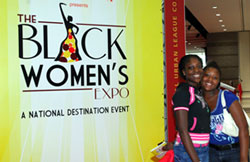
The Black Women's Expo and the Urban League combined forces in these tight economic times. Photos: Richard B. Muhammad
|
The conference's theme embodies a shift the 99-year-old advocacy organization is taking. The organization was founded on principles aimed at helping Blacks better their lives after moving North from the South.
But as the struggle for civil rights began in the '50s and '60s, the Urban League worked to address socio-economic barriers that disenfranchised Blacks. Since the economy has become more global, the Urban League now sees sustaining Black economic empowerment as a means to improving Black communities.
“Where we are today is a focus on economic empowerment. So many of our community's challenges relate to economics and therefore the solutions are economic solutions,” said Urban League executive director Marc Morial, in an exclusive interview. (See One on One this page.)
“One of the things we have to push more in the direction of is economic self-sufficiency and as you know the Honorable Elijah Muhammad was one of the earliest pioneers in the 20th century in promoting ownership of businesses that serve our community. The League is squarely behind that kind of thinking and we devoted a great deal of activity at this conference to entrepreneurship, wealth building and asset protection—helping people who may be in trouble because of the subprime crisis, helping people who are in fact looking for a job or a better job,” he said.
The Chicago Urban League embraced that focus two years ago. While Cheryle Jackson said there are many groups addressing the socio-economic conditions impacting Blacks, few center on economic empowerment and wealth creation.
“They just manage people in a problem,” Ms. Jackson said of social-oriented organizations. “They do not or cannot manage people out of a problem, and that is what economic development and economic empowerment is.”
Problems preventing Blacks from achieving economic success are complex. But Ms. Jackson explained detractors want to point to the “emotional” side of the problem—blaming Black high school dropout rates on lack of parental involvement or misplaced values. Society blames individuals, she said, instead of addressing laws and policies that create uneven playing fields. Policies on access to capital and contracting create some of those uneven playing fields, Ms. Jackson noted.
Revenue caps on minority and disadvantaged business enterprise programs often prevent Blacks from going after bigger contracts.
“Those are policies that limit and cap growth for minority businesses,” she said.
U.S. Rep. Barbara Lee (D-Calif.) agreed. Rep. Lee was honored with several other Black women for their leadership roles within their respective careers at the conference. Congresswoman Lee said the federal government must do its part to support economic empowerment within the Black community.
She noted federal agencies, loan programs and financial institutions should be more accessible to Black businesses. With federal resources and capital, Blacks can develop their own economic base, create jobs, provide health care and support education. Rep. Lee said that is the path to economic empowerment which in turn improves the Black condition.
“If we are developing our own and running our own businesses and hire people (then) we provide pathways out of poverty,” she said.
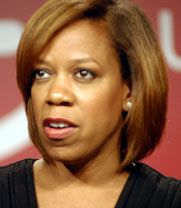
Cheryle Jackson of the Chicago Urban League
|
“It is about being smart on how we build our capacity and train our workforce,” she said.
The Chicago Urban League started ProjectNext, a business development program, to grow Black businesses by connecting them with resources to make them more competitive. She noted that if Blacks are more financially self-sufficient “they can begin to fix problems within their own communities.”
The Greater Cincinnati Urban League offers a similar program to sustain Black businesses. Donna Jones Baker, GCUL's president and CEO, said her organization has always focused on economic and business development. Ms. Baker contends sustaining a community's viability goes beyond just getting someone a job.
“We have huge unemployment in the African-American community in Cincinnati,” she said. “We have a great need to build more businesses who can hire more people and African-American businesses hire African-Americans.”
With double digit unemployment and high foreclosure rates that are destabilizing Detroit's Black communities, that city's chapter president considers economic empowerment as a bailout package for the Black community.
N. Charles Anderson contends President Obama's auto industry bailout package has not stopped job losses. He said the bailout packages have allowed companies to retool their businesses, but that has not affected the average citizen.
Mr. Anderson believes economic empowerment means business development, quality education and political involvement.
“We cannot idly sit by, read the paper, look at the news and not get active ourselves,” he said.
The biggest threat to Black economic empowerment is desegregation contends Kirk Mayes, an organizer with the Detroit-based National Community Development Institute, a capacity building organization for nonprofits. While desegregation leveled the playing field for Blacks to compete with other races, it also had some drawbacks, Mr. Mayes added.
He said desegregation defused the commonality that bounded Blacks together. The Holocaust, however, is the thread that ties the Jewish community together promoting patronage among each other's businesses, he noted. But desegregation created “so many different opportunities that take us 360 degrees in the other direction from the center, which is the Black community,” Mr. Mayes explained.
“United we stand, divided we will fall,” he added. “Without ... unity, we won't be able to rise as a people. We can be successful as individuals, but you can only go so far if your neighbor is still lagging behind.”
Related links:
'The goal is parity' - One-on-One with National Urban League President and CEO Marc Morial (FCN, 08-04-2009)
Urban League offers solutions to problems (FCN, 04-10-2009)
The National Urban League (National Site)

News Search
Loading
Follow The FinalCall.com Networks



Join The FinalCall.com e-List


 Click Here Stay Connected!


For Email Marketing you can trust
Farrakhan Articles
- Unmasking Mr. Dershowitz
- Activists charge environmental poisoning and ‘silent homicide’ in San Francisco
- President spews more incendiary rhetoric as election draws closer
- Covid-19 and the divine chastisement of Florida
- The National Guard was deployed in Atlanta, what does this mean as shootings, violence plague other American cities?
- Our babies are dying, where are our friends?
- Hurling truth at Falsehood Nation of Islam responds to lies of Atty. Alan Dershowitz
- The impact of a universal message
- Police traffic stops in nation’s capital disproportionately target Blacks
- A Call to Action’ to address Covid-19 in Black Chicago
INSIDE STORIES AND REVIEWS
-

-

About Harriett ... and the Negro Hollywood Road Show
By Rabiah Muhammad, Guest Columnist » Full Story -

Skepticism greets Jay-Z, NFL talk of inspiring change
By Bryan 18X Crawford and Richard B. Muhammad The Final Call Newspaper @TheFinalCall » Full Story -

The painful problem of Black girls and suicide
By Charlene Muhammad -National Correspondent- » Full Story -

-

-

-

Exploitation of Innocence - Report: Perceptions, policies hurting Black girls
By Charlene Muhammad -National Correspondent- » Full Story -

Big Ballin: Big ideas fuel a father’s Big Baller Brand and brash business sense
By Bryan Crawford -Contributing Writer- » Full Story -
